MASTILOVIĆ: TREASURY OF OLD ORTHODOX CHURCH IN SARAJEVO KEEPS PRICELESS TREASURE
FBiH - Sarajevo - property of Serbs and the SOC /4/
06/29/2026
10:39
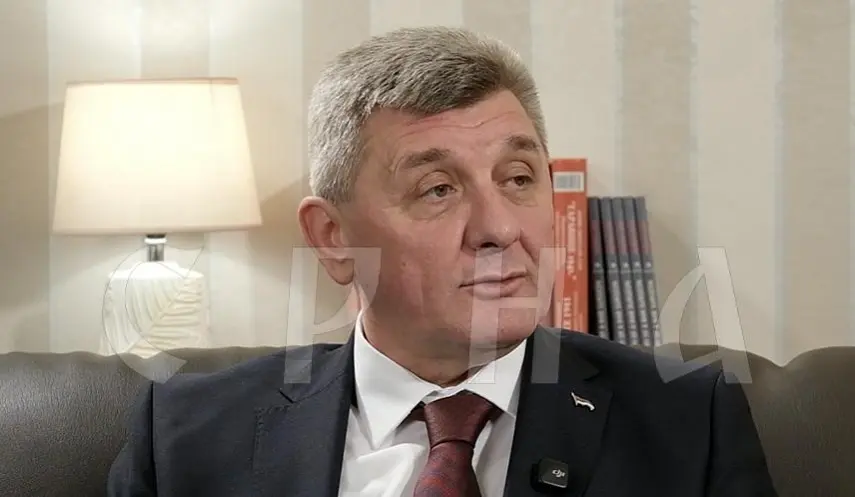
SARAJEVO, JUNE 29 /SRNA/ - Historian Draga Mastilović told SRNA that the Treasury of the Old Sarajevo Orthodox Church hides a priceless treasure of the Serbian Orthodox people not only in the Sarajevo area but also throughout BiH, and he revealed that it contains, among other things, money from the time of Emperor Dušan and the Sarajevo copy of the laws and regulations of St. Sava from the 13th century.
Written by: Željka DOMAZET
Mastilović points out that the Treasury contains a lot, starting with archival materials dating back to the Middle Ages, old church books and copies.
"There is also the Sarajevo copy of the Code of Laws of St. Sava, which is truly something magnificent and something we as a people can be proud of," Mastilović emphasized.
In addition, he says, the collection hides a large number of documents from the Ottoman period, as well as in Old Greek, Old Slavonic and Church Slavonic.
"As for the archival materials of the Old Church or the Treasury of the Old Church, it is a priceless treasure. There are also old icons from the 16th and 17th centuries that will need to be restored at some point, as well as other church artifacts that testify to the deep history and presence of the Serbian people in these areas and in Sarajevo itself," Mastilović stated.
A SQUARE CALLED TORNIK
He notes that one must bear in mind the fact that the Turks found a medieval square in this area at the place where Sarajevo is today, which was called Tornik, and it is even mentioned in Turkish documents under that name, while the presence of the Serbian Orthodox people can be traced through historical documents from the early Middle Ages to the present day.
Mastilović stated that this undoubtedly testifies to the presence of Serbs in that area, and that the Treasury of the Old Orthodox Church in Sarajevo speaks of their cultural and spiritual dimension, what this people actually meant to the city on the Miljacka River, even though they were often brought to the brink of survival during the Ottoman period.
He pointed out that today Serbs have been expelled from Sarajevo and that the property of the Serbian Orthodox Church has not been returned, and that attempts are being made to erase all mentions of Serbs and their culture in the city.
"Unfortunately, at the end of the 20th century, we have been brought to the point where Serbs in Sarajevo are once again on the brink of survival, except for East Sarajevo of course, but these artifacts in the Treasury of the Old Sarajevo Church undoubtedly testify not only to the presence of Serbs, but also to their spiritual and cultural dimension, architecture and many other aspects that show that Serbs are in fact the ones who not only built Sarajevo, but also created its spiritual and cultural dimension," Mastilović pointed out.
NATIONAL TREASURE OF THE SARAJEVO SERBS AND THE SOC MUST BE PRESERVED
Mastilović, who is also the Minister of Scientific and Technological Development and Higher Education of Republika Srpska, stated that the Serbian people have an obligation to preserve, through the culture of memory, above all, the cultural and national treasure that the Sarajevo Serbs have created over the centuries, which is today stored in the Treasury of the Old Sarajevo Church.
"In the Treasury, there is money from before Christ to the present day. I was lucky enough to be able to enter the Treasury of the Old Sarajevo Church with the blessing of Metropolitan Hrizostom of Dabar-Bosnia and to be speechless as a historian from everything that is there. The Treasury contains money from the time of Emperor Dušan, in large quantities," Mastilović stated.
There, he says, in addition to archival materials and church books that have not yet been researched - materials in different languages - there are icons that are truly a cultural treasure of the Serbian people.
"I am impressed by an icon that the monks of Dečani donated to the Old Sarajevo Church in 1793 as a token of gratitude for the help that the Sarajevo Serbs provided to the Visoki Dečani monastery," Mastilović revealed.
Mastilović stated that throughout the centuries of difficult Ottoman slavery, the Sarajevo Serbs, and above all the bourgeois class, merchants and artisans, supported Serbian monasteries throughout the Serbian lands, including Visoki Dečani, Mileševo.
"We can find evidence of all this today in the Treasury of the Old Sarajevo Church. That is what will be the basis, and I hope that very soon Metropolitan Hrizostom has a great vision to create a museum of the Metropolis of Dabar-Bosnia, which will truly be a permanent testimony to the presence of the Serbian people in this area and their spiritual, architectural and cultural feats that they created throughout the centuries in that area," Mastilović emphasized. /to be continued/