KULJANIN: VICTIMS' FAMILIES HURT BY ANNOUNCED CONSTRUCTION OF MONUMENT AT IVAN SEDLO
FBiH - Bradina - crime against Serbs
05/25/2026
14:14

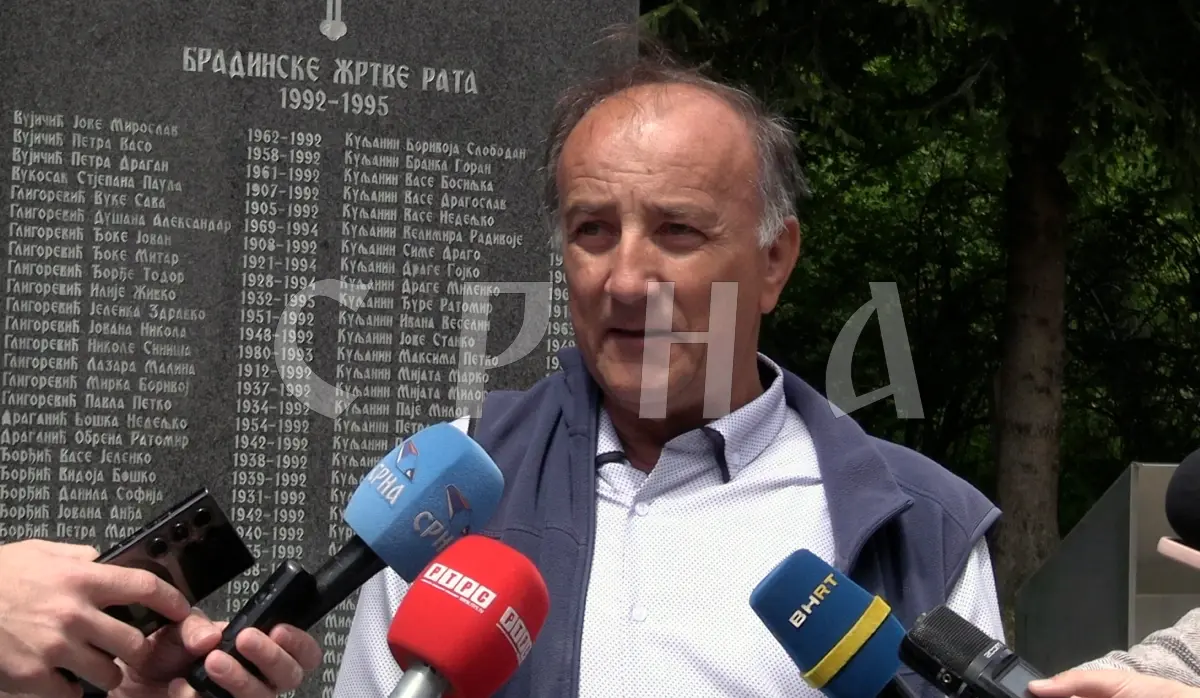
BRADINA, MAY 25 /SRNA/ – Former Bradina resident Milivoje Kuljanin says that families of Serbs killed during the attack by Muslim and Croat units on the village in May 1992 are particularly distressed by the announced construction of a monument at Ivan Sedlo dedicated to, as presented in the FBiH, "magnificent victory over the Chetnik aggressor," although the victims here were Serb civilians.
"That day my brother was killed here. He was wounded. My father wanted to take him to Konjic, but they would not allow it. When the village was raided, he was killed and mutilated in front of the house," said Kuljanin, who is attending the commemoration marking 34 years since the suffering of Serb civilians in Bradina.
Envoy of the Serb BiH Presidency member, Boško Tomić, says that people have for years gathered in the Bradina area for memorial services and to preserve the memory of the murdered Serbs, but that a judicial outcome for this crime remains absent.
"When Serb victims are concerned, everything moves slowly or almost not at all. In this area, where Serbs once lived, almost none remain today," Tomić told the press in Bradina.
He recalled that civilians, including women and children, were killed in Bradina, and that in many communities across BiH the Serb population has today been reduced to a small number compared with the pre-war period.
Tomić called for respect for the Dayton Peace Agreement and strengthening political stability, with the message that tragedies from the past must never be repeated.
Istočno Sarajevo Mayor Ljubiša Ćosić says that Bradina is a symbol of the suffering of Serb civilians and that the victims must not be forgotten.
He stated that civilians were killed during 1992 and that this was a grave crime against a population that had lived on its ancestral land for centuries.
"Crimes against civilians are the gravest crimes and a warning that such things must never happen again," Ćosić said, adding that justice for Serb victims has so far been slow and insufficient.
According to him, justice has least often reached those who killed Serbs, which is why everyone has an obligation to preserve the memory of the victims of these crimes.
Criminals of Muslim and Croat forces killed 48 Serb civilians in Bradina in an especially brutal manner, expelled others and sent them to prison camps, while the Orthodox church was burned and demolished.
Over three days, from May 25 to 27, 1992, Bosniak and Croat evildoers threw 26 bodies into a pit in front of the Orthodox church in Bradina. Another 22 Serb civilians died in prison camps, while five persons are still missing.
Among the 48 Serbs killed in Bradina, the largest number were members of the Kuljanin family, as well as the members of the Vujičić, Mrkajić, Žuža, Kureš, Gligorević, Koprivica, Draganić, and Živak families.
The remaining Serb population was expelled from their homes, their movable property looted, and their houses and church burned. Before the war, Bradina had 280 Serb-owned houses with approximately 1,200 residents.
No one has yet been held accountable for the Bradina crime, although proceedings are ongoing before the Court of BiH against several former members of the then Army of BiH and HVO in the Esad Ramić et al. case, who are charged with killings, torture, and persecution of the Serb population in Bradina and the surrounding area.