ATTACKS ON PROPERTY AND RELOCATION OF CEMETERIES
FBiH - Sarajevo - property of Serbs and the SOC /3/
06/28/2026
09:58

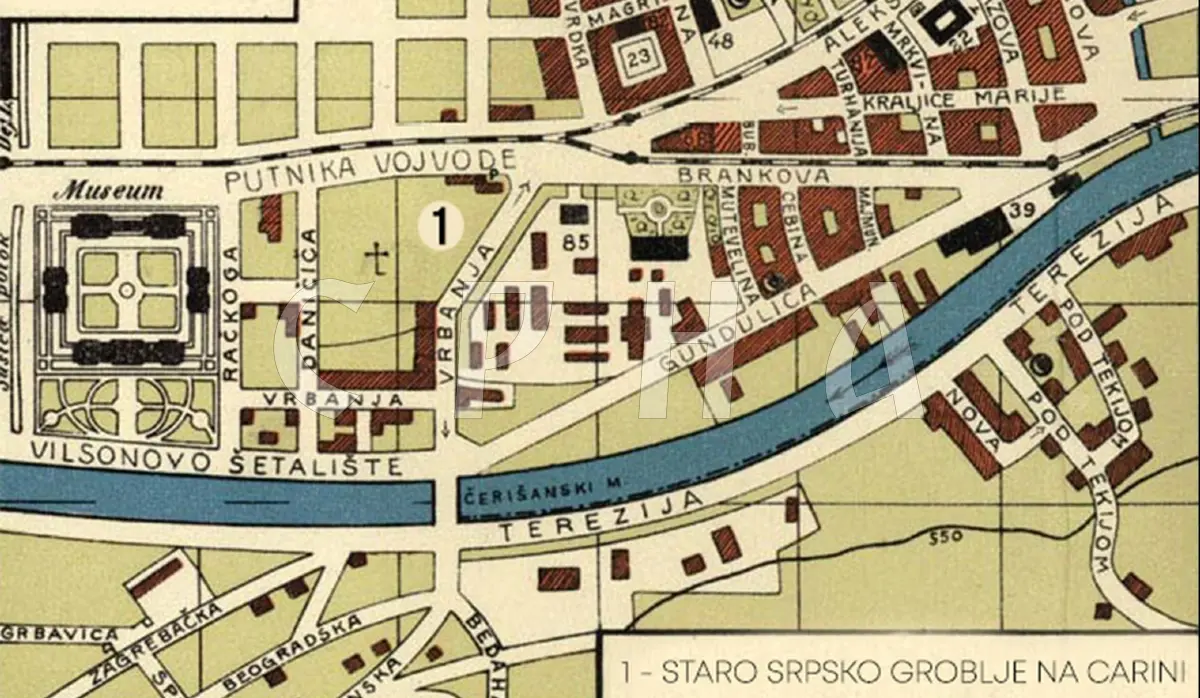
SARAJEVO, JUNE 28 /SRNA/ - Publicist Dragan Mijović told SRNA that traces of ownership of Orthodox property in Sarajevo have long been erased and that some sources mention a document from the 1660s in which the Serbian-Orthodox Church Municipality was registered as the owner of a cemetery located in the area where the Parliamentary Assembly and Council of Ministers buildings are today, and which was destroyed in one of the numerous arson attacks on the Old Church and the Serb town of Sarajevo.
Written by: Željka DOMAZET
"It is also mentioned that the cemetery was once registered with the restored Serbian Patriarchate in Peć /1577-1766/ in order to better legally protect the cemetery, and especially the very attractive free part of the plot, from local Turkish strongmen, greedy for material goods," Mijović pointed out.
He says that the Serbian patriarch could have intervened much more strongly with the Travnik vizier, and with the grand vizier in Constantinople himself, especially during the mandate of Sokollu /Sokolović/ Mehmed Pasha /1565-1579/, a Turkified Serb who had the Peć Patriarchate restored, headed by his brother Makarije Sokolović.
"There are written traces that during the 17th century, the Serbian-Orthodox Church Municipality repeatedly requested and received protection of the Bosnian vizier from the arbitrariness of local princes who wanted to impose a tax on the cemetery plot, which was once written about in the newspaper Javor by Metropolitan Sava Kosanović," Mijović noted.
ATTACKS ON PROPERTY
Mijović pointed out that there were other ruthless attacks on the cemetery.
"During the fortification of the gatehouse and the construction of the Yellow Tabija Tower in 1729, by order of the Bosnian vizier Ahmet Pasha of Skopje, hundreds of the oldest medieval tombstones, stone crosses and other monuments were taken from the cemetery and built. With them, valuable testimony of past centuries disappeared," Mijović states.
He reveals that a similar thing was done when the Miljacka River bed was fortified.
"At Vasiljeva Bašča /Vasilj's Garden/, the monuments were made of stone from nearby quarries, mostly `from our Reša`. It should be noted that there were few simple, small crosses; at that time, very solid crosses prevailed in size and workmanship, which speaks of the good material status of the inhabitants of that time. Among them, dozens of monuments of wealthier Serbian merchant, artisan and priestly families stood out," Mijović pointed out.
He states that the monuments and tombs of three Serbian bishops - Aksentije of Zahumlje-Herzegovina /1751-1760/, Paisije of Dabar-Bosna /1794-1802/ and Joanikije of Zvornik /1804-1807/ were particularly monumental.
"They were made of fine stone with masterfully crafted ornaments and inscriptions with the coats of arms of their dioceses. Even without special expertise, it was visible that the massive tombstones had been moved, broken and chipped due to looting," Mijović reveals.
THE EXECUTION GROUND
Mijović says that during the period of Austrian rule, on the eastern side of the cemetery, on the site of today's Sarajevo City Center, the first tobacco factory was built in 1882, which was moved to its current location in Pofalići in 1960.
"It is little known that at that very place, next to the cemetery fence, there was a place of execution for the Turkish landowner, where criminals were executed by strangulation with a cord, beheading, and later by hanging. Immediately next to the northern side of the cemetery, a railway station for the so-called Ilidža train was built. The track roughly coincided with today's tram line that runs from Marijin Dvor to the west. Because of these dominant buildings, some people also called the cemetery `by the Ilidža station` or `by the tobacco factory,`" stated Mijović.
Mijović, who deals with historical facts, notes that later, with the expansion of the city, its urban parts reached the once peripheral customs and the cemetery fence itself.
CEMETERY OF HOLY ARCHANGELS MICHAEL AND GABRIEL
"By an act of August 3, 1882, the government commissioner for Sarajevo banned further burials due to `health concerns`. In the area near the current Faculty of Philosophy, there was an empty space, without graves, which at times served as a haystack or military landfill. Due to the ban, the Serbs hastily opened a cemetery on the slope of Trebević above Kovačići. However, even that was contested, which forced the municipality to quickly buy a plot of land on Koševo in September 1884, which the government had allocated to them, at a bargain price, and a new cemetery of the Holy Archangels Michael and Gabriel was formed there," Mijović stated.
Mijović specifies that the cemetery was consecrated on October 12, 1884, by Metropolitan Sava Kosanović.
"During the ottoman period, a small part of the cemetery `on Carina` was leased to the Catholic community for burial purposes. However, after the Austro-Hungarian occupation, they, as members of the `imperial faith,` became favorites of those authorities, who openly favored them in every way, so that the Catholic Church, personified by the aggressive Bishop Stadler, suddenly asserted its right to half of the entire cemetery plot.
A ten-year lawsuit was initiated, which ended with a verdict in their favor in February 1915, in circumstances when the persecuted Serbian community did not dare to raise an objection, and even if it had, the outcome of that judicial farce would have been the same. It is completely clear that there can be no question of their `historical centuries-old right,` when it was only in the mid-19th century, with the help of the Serbs, that Fra Grga Martić built a small chapel as the first Catholic place of worship in Sarajevo," says Mijović.
EXHUMATION
Mijović adds that in the new state of the Kingdom of Serbs, Croats and Slovenes, the city authorities once again raised the issue of the Cemetery at Carina, which should be exhumed for the further urbanization of that area.
"The church municipality agreed to the exhumation and transfer of the grave remains to the new Orthodox cemetery in Koševo, only when it was stipulated in the urban plan that a seminary building with an associated church would be built on part of that plot. At that time, the Serbian-Orthodox Church Municipality paid the Catholics a hefty sum of 500 thousand dinars for their part of the cemetery," Mijović reveals.
He noted that the digging up of the cemetery in Carina and the exhumation were planned for June 1935, but that it was constantly postponed so that the work finally began only in March 1939.
Mijović said that this is a very extensive and interesting story that he leaves with SRNA and intends to tell in the continuation of this series about the property of Serbs in Sarajevo.

FALSIFIED PARDON DOCUMENTS PUBLISHED IN CONNECTION WITH CANOPY COLLAPSE CASE

FERTILE AGRICULTURAL LAND MUST BE PROTECTED FROM SOLAR PROJECTS

VANCE: EUROPE RELIES ON USA, WHILE CRITICIZING PARTNERS
OPPOSITION ACCUSES GOVERNMENT OF VIOLENCE AS CLASHES ERUPT IN ALBANIAN PARLIAMENT