SARAJEVO ASSASSINATION – SHOTS FIRED AT OCCUPIER
BiH - Vidovdan - anniversary
06/28/2026
11:35
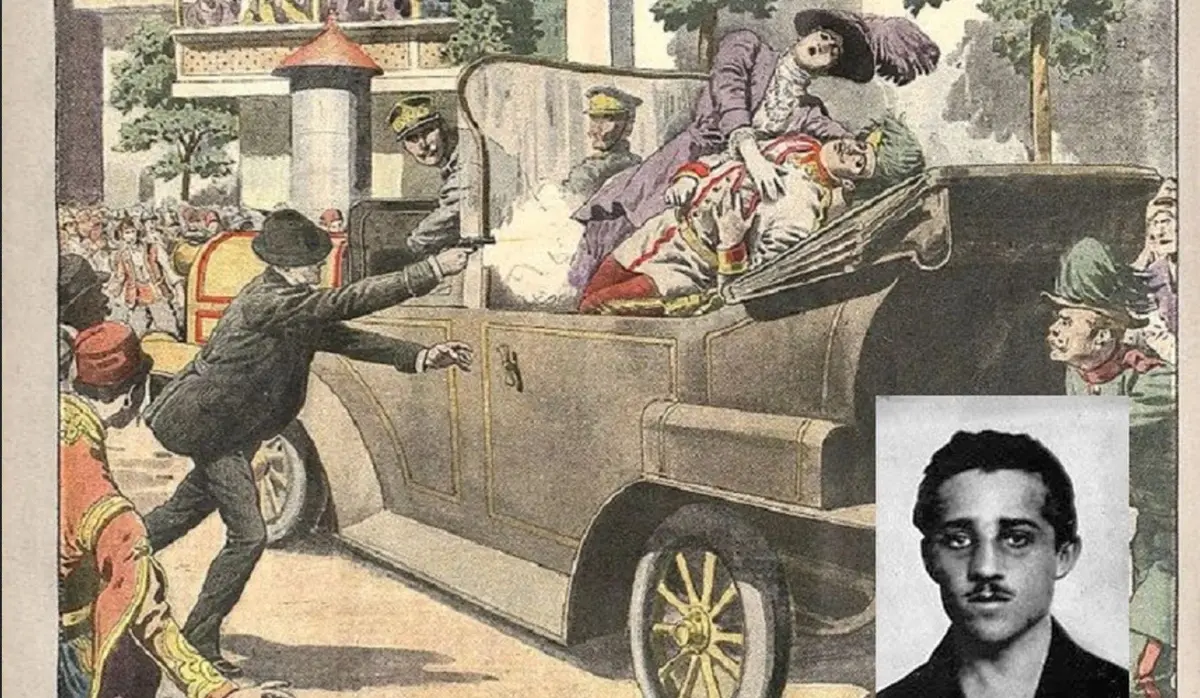
BIJELJINA, JUNE 28 /SRNA/ – On this day in 1914, Gavrilo Princip, a member of the Young Bosnia movement, assassinated Austro-Hungarian Archduke Franz Ferdinand in Sarajevo, which served as the pretext for the Austro-Hungarian authorities to launch a military invasion against Serbia, ultimately leading to the outbreak of the First World War.
Franz Ferdinand's wife, Sophie Chotek, also died after being accidentally wounded in the attack.
Young Bosnia members carried out the assassination as a protest against Austro-Hungarian occupation policies and in pursuit of the aspirations of the then majority Serb population in BiH, as well as members of other nations and faiths, for liberation and unification.
Seven people took part in the assassination, positioned along the route from the site of the military manoeuvres to City Hall.
They were Muhamed Mehmedbašić, Vaso Čubrilović, Nedeljko Čabrinović /who threw a bomb at the motorcade, which the Archduke deflected from the roof of his car, causing it to explode beneath the following vehicle/, Cvjetko Popović, Danilo Ilić, Trifko Grabež and Gavrilo Princip.
After hearing the explosion, Princip and the other Young Bosnia members left their positions.
Then, by a twist of fate, the car carrying Franz Ferdinand passed by Gavrilo Princip, who seized the opportunity and drew his pistol.
The first shot wounded Franz Ferdinand in the neck, while the second, intended for the then governor of BiH, Oskar Potiorek, struck Sophie in the abdomen. Both succumbed to their injuries on the way to the governor's residence.
Princip jumped into the Miljacka River and attempted to commit suicide by taking a cyanide capsule, but failed. He then tried to shoot himself in the head, but gendarmes overpowered and arrested him before he could do so.
Following the assassination of Franz Ferdinand, 25 young men were brought before the court on October 12, 1914. They were tried in the staged "Sarajevo Trial," held from October 12 to 23, with verdicts delivered on October 28.
Under Austro-Hungarian law, the death penalty could not be imposed on persons under the age of 20 at the time of the offence. Nedeljko Čabrinović, Gavrilo Princip and Trifko Grabež were therefore sentenced to the maximum penalty of 20 years' imprisonment, during which they were subjected to severe torture.
Vaso Čubrilović was sentenced to 16 years in prison, while Cvjetko Popović received a 13-year sentence.
Veljko Čubrilović, Mihajlo Jovanović and Danilo Ilić, who had assisted the Young Bosnia members in carrying out the assassination, were executed by hanging in Sarajevo on February 3, 1915.
The oldest among them, Veljko Čubrilović, wrote a letter to his family on the night before his execution. The original was ordered destroyed by the court, but the prison guard took pity on him, copied the letter, and only then burned the original.
His moving words, written by a man facing imminent death, expressed his belief that his sacrifice would not be in vain and that freedom would one day "warm" everyone, including his one-year-old daughter Nada.
Muhamed Mehmedbašić was the only assassin who managed to escape Sarajevo after Gavrilo Princip's historic and heroic shots. He fled across the mountains to Nikšić in Montenegro.
Believing he was safe there, he began speaking openly about his role in the assassination. Fearing that word of his presence would reach the Austro-Hungarian authorities, the Montenegrin authorities imprisoned him and secretly transferred him to Serbia. As a second lieutenant, he took part in the Serbian Army's retreat across Albania.
He returned to Sarajevo in 1919, but was arrested by the Ustasha in 1943. He endured severe torture in prison and died on May 29, 1943, from its consequences.
Gavrilo Princip served his sentence in the Terezín prison in what is now the Czech Republic, where he died on April 28, 1918. Toward the end of his life, he was severely weakened, weighing only 40 kilograms because of harsh prison conditions, imprisonment and torture.
On the wall of the cell in which he died, Princip wrote: "Our shadows will walk through Vienna, wander through the court, frightening the gentlemen..."
On his prison tin plate, recalling the night before the assassination when the Vidovdan heroes swore at the grave of Young Bosnia member Bogdan Žerajić that they would complete the mission he had begun, Princip engraved the following verses: "Time drags slowly on, and nothing ever changes; today is like yesterday, tomorrow prepares the same. Žerajić, that grey Serb falcon, spoke the truth: He who wishes to live, let him die; he who wishes to die, let him live".
After the First World War, on July 7, 1920, the remains of the Vidovdan heroes were transferred and buried in a single grave in Sarajevo. In 1939, their remains were finally laid to rest in the Chapel of the Vidovdan Heroes at the Orthodox cemetery in the Koševo district of Sarajevo.
The authorities of the Kingdom of Yugoslavia placed a memorial plaque at the site where Princip carried out the assassination, but occupying German and Ustasha forces removed it in 1941 and presented it as a gift to Nazi leader Adolf Hitler.
After the Second World War, a new plaque was installed at the same location bearing the inscription: "From this place, on June 28, 1914, Gavrilo Princip, with his shots, expressed the people's protest against tyranny and the centuries-old aspiration of our peoples for freedom".
According to the article, that plaque was destroyed with sledgehammers during the 1992–1995 war in BiH by members of the Muslim army, along with Princip's footprints embedded at the assassination site in front of the Young Bosnia Museum.
A bridge in Sarajevo near the assassination site was named Princip Bridge in 1918, but after the 1992–1995 war the Sarajevo authorities restored its former name, Latin Bridge.
Princip's birthplace, which had been burned during the Second World War, rebuilt in 1964 and converted into a memorial museum dedicated to him, was set on fire again in 1992.
With the departure of the Serb population from federal Sarajevo, the spirit of Young Bosnia also disappeared.