KOVAČEVIĆ: SCHMIDT NO LONGER HAS BACKING FOR ANY DECISIONS
BiH - Republika Srpska - foreign interventionism
05/27/2026
22:34
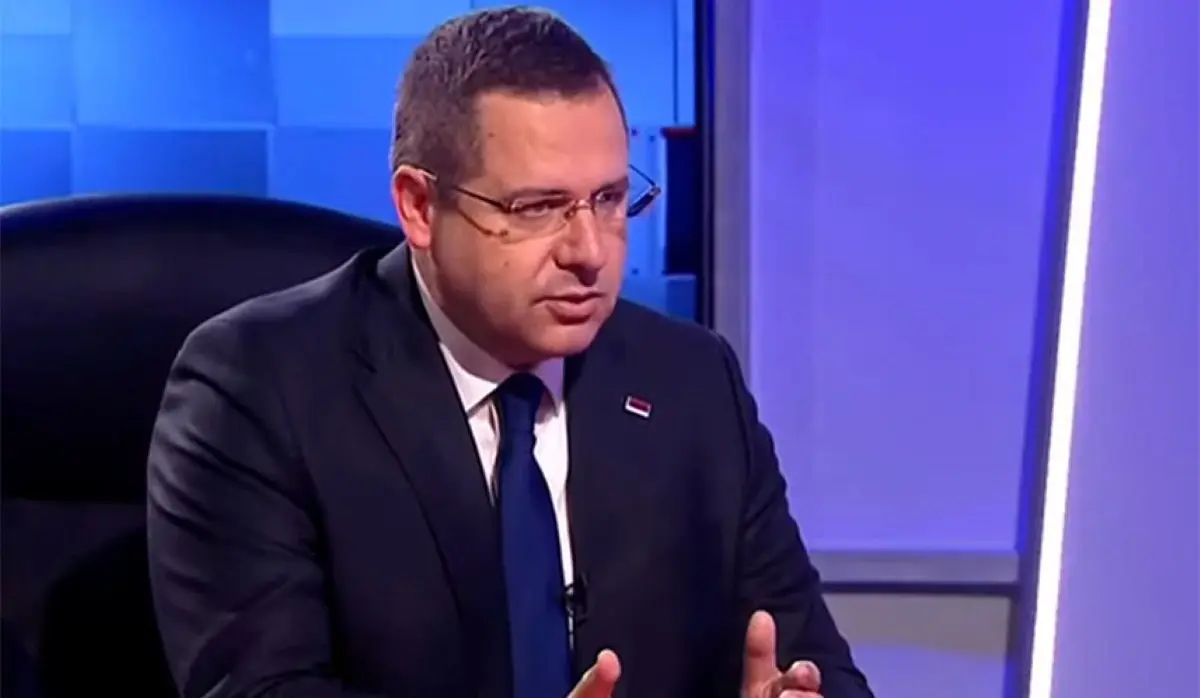
BANJA LUKA, MAY 27 /SRNA/ - Serb delegate in the House of Peoples of the BiH Parliamentary Assembly Radovan Kovačević said that Christian Schmidt no longer has support for making any decisions and that, should he attempt to take any action regarding "state property", Republika Srpska would be part of a broad international coalition that would successfully oppose it.
Kovačević stressed that Schmidt previously had backing from very serious international addresses for everything he did, but that Republika Srpska had not backed down in its opposition to him, despite confronting not only Schmidt but also all those he represents and who support him.
He reminded that Schmidt arbitrarily changed laws and procedures in BiH while violating the BiH Constitution and emphasized that he had failed in his intention to destroy Republika Srpska.
"Through the policy of Milorad Dodik, implemented by Milorad Dodik, Željka Cvijanović, Ana Trišić-Babić and several of us, we have reached the point where Christian Schmidt is leaving. We definitely consider that a success", Kovačević told RTRS.
Noting that Schmidt had not been legitimately appointed, Kovačević said the position of High Representative does not even exist in the BiH Constitution, but is mentioned in Annex 10 of the Dayton Agreement, which defines that the High Representative is chosen by the signatory parties to the annex, including Republika Srpska.
Annex 10 of the Dayton Agreement also states that the High Representative is appointed through a relevant UN Security Council resolution and has a mandate not to intervene, but to moderate, Kovačević added.
He said Republika Srpska, as a signatory to the Dayton Agreement and Annex 10, has no objection to moderation.
Kovačević reminded that Schmidt imposed amendments to the Criminal Code entirely contrary to the Constitution and the Dayton Agreement, after which Republika Srpska President Milorad Dodik was prosecuted and put on trial.
"So someone elected by the people of Republika Srpska to lead Republika Srpska and this people was ultimately stripped of the position granted to him by voters?" Kovačević asked.
He said this nullified the electoral will of both the Serb people and all citizens of Republika Srpska.
Kovačević reminded that SNSD was the convincing winner of the last general elections in BiH, receiving the highest number of votes, which, he said, demonstrates the party's democratic legitimacy.
"And then some Dino, Pinocchio, Konaković, whatever they call him, says - 'We will erase them with an eraser'. But this is not about us. This is about the democratic legitimacy we represent. And when we speak about Sarajevo and the BiH level, we do not represent only our voters. We are an expression of the will of Republika Srpska and the Serb people. Then they threaten us with bulldozers and other nonsense. And of course, afterward they say they do not want to negotiate with us", Kovačević said.
He added that SNSD is the last address that should be asked for agreements under such circumstances.
Regarding the appointment of a new High Representative, Kovačević said that, from Republika Srpska's perspective, such a position is unnecessary.
"We are not interested in any High Representative", Kovačević said, adding that Republika Srpska would nevertheless act in accordance with the Dayton Agreement and UN Security Council resolutions.
Kovačević stressed that no outside intervention can replace an agreement among domestically elected politicians, something political Sarajevo often relies upon.
"This is something that finally needs to happen. To free ourselves from those imposing decisions in anyone's interest, even if it were in the interest of Republika Srpska and for representatives of Republika Srpska, representatives of the Federation, and representatives of the three constituent peoples, as defined by the Constitution, to sit down and negotiate. On some issues we may never reach agreement, on others we may agree immediately. But that is the only way any country should function,” Kovačević concluded.