KARAN: EVEN TODAY THERE ARE THOSE WHO WOULD OPPOSE BOTH DAYTON AND LEGAL LOGIC JUST TO PRESERVE PROTECTORATE IN BiH
BiH - PIC - response
06/05/2026
13:23
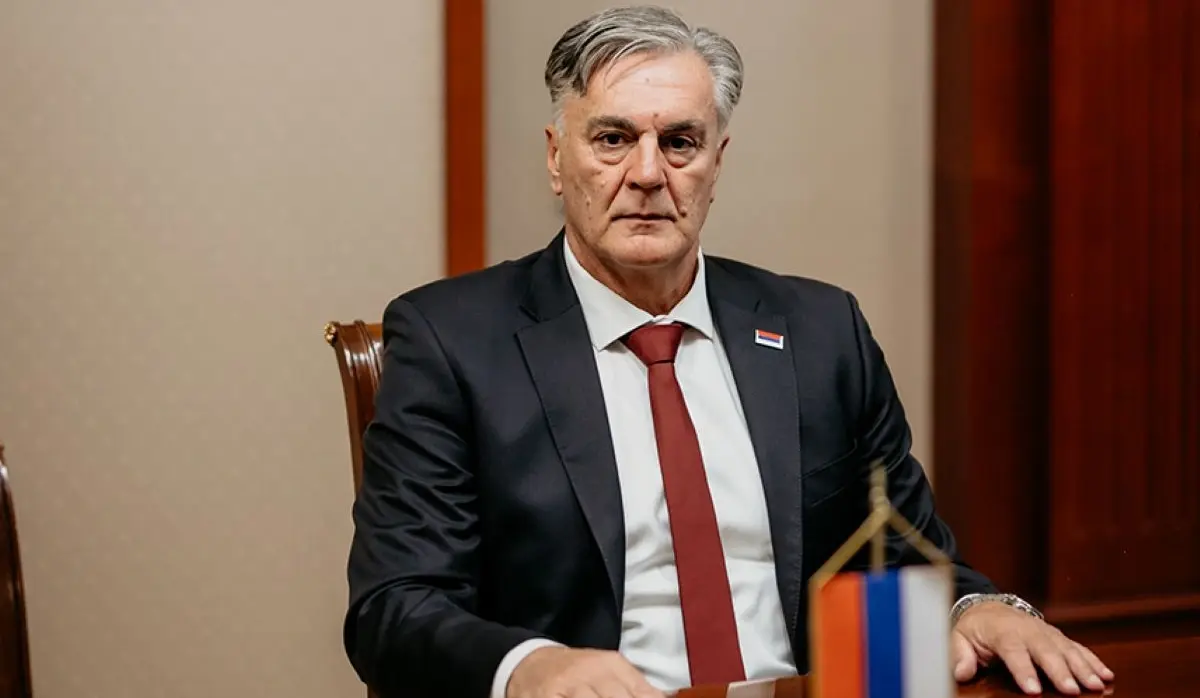
BANJA LUKA, JUNE 5 /SRNA/ - Professor of Constitutional Law Siniša Karan told SRNA that the last session of the Peace Implementation Council /PIC/ was not an extraordinary or historical event in itself, but another link in a thirty-year long chain of systematic collapse of Dayton BiH and attempts to create a unitary BiH.
At the request to comment on the last two-day session of PIC, Karan told SRNA that two things have to be clear from the very beginning, and there must not be any confusion about these two things.
"First, the PIC cannot appoint a high representative, and this is not a matter of interpretation or political assessment, it is a legal fact. According to Annex 10, the high representative is proposed by the signatories of the Dayton Agreement, and Republika Srpska is also a party.
Second, the corresponding resolution of the UN Security Council is not just a mere formality, but the essence of the whole process. That resolution precisely determines the tasks of the high representative, and only what is written in Annex 10 can be written in it. There is no need to interpret or add anything here, it is enough to read it," Karan explained.
He stated that the sides agreed that the new representative will be appointed to implement the civilian aspect of a peaceful solution, fulfilling the tasks given by the resolution of the UN Security Council.
Also, Professor Karan added, Annex 10 clearly stipulates that the mandate of the High Representative includes the decisively stated duties: to supervise the implementation of the peace settlement, to maintain contacts with the signatory parties, to coordinate the activities of civil authorities and bodies in BiH, to facilitate the resolution of any problems that arise in connection with the implementation of civilian aspects, to participate in meetings of organizations that provide assistance, to periodically submit reports on the progress of the implementation of the peace agreement and to give instructions to the Commissariat and to receive reports from the Commissariat of International Forces.
"Therefore, the high representative does not impose, he does not enact laws, does not replace the elected officials, and does not shape constitutional governing of the sovereign state. Anything that goes beyond the scope of his mandate has no legal basis in the Dayton Peace Agreement, and no conference, declaration or directive of the PIC can change that," Karan emphasized.
He reminded that PIC does not exist in the Dayton Peace Agreement, and that it was constituted by the London Declaration in December 8 and 9, 1995, after the Dayton.
"Conferences followed one after another: London, Sintra, Bonn, Luxembourg, Madrid, Brussels, and in each of them one and the same concept was built with the same goal. With the constant support of the international factor, a political environment was created in which the powers of the high representative are applied as if they had always existed," Karan told SRNA.
Everything that gradually but systematically transformed BiH in the direction of a unitary state over the course of thirty years, he pointed out, was done precisely in that body that Dayton does not know.
"The complete mechanism they created: the PIC gives the order, and the high representative imposes the decision, had one sole function - to be a tool with which to build a unitary Bosniak BiH, and to destroy a multi-ethnic federation in which the three peoples are equal. This is undisguisedly confirmed today by those who built that mechanism," emphasized Karan.
He reiterated that BiH is what its two entities and three constituent peoples want, it has the powers and functions that Republika Srpska and the Federation of BiH gave it, and their will on these issues is visible from a single authoritative document, the Dayton Peace Agreement, and not from London declarations, Bonn guidelines, and Madrid conclusions.
"Dayton and nothing else," said Karan.
He added that today we are witnessing an open collision of two concepts.
"On the one hand, there is the sovereignist concept of the American administration under the leadership of President Donald Trump, which starts from the fact that BiH is a country where decisions are made by local leaders, and international actors help instead of dictating, and in which the OHR was never intended to be permanent," explained Karan.
He stated that Republika Srpska fully supports that position, and believes that it is time to bring the mandate of the high representative to an end and leave the future of this country to the elected representatives of the people, because that is sovereignty.
"On the other hand, there is the unitarist concept, which is supported by certain European centers of political power that persistently and without stopping continue to build a Bosniak unitary civil state, and for which Dayton has long been a dead letter, and PIC is an irreplaceable tool with which that new state is gradually shaped and imposed," Karan added.
At the same time, he says, it is necessary to say something that is happening more and more often in the public space - the European Union is no longer what it was, and it no longer rests on the postulates on which it was created.
"Today, it is mobilizing and positioning itself more and more openly as a military alliance, which inevitably raises the question of whether and to what extent the process of European integration still has the meaning and content attributed to it.
And that's where we come to what everything says: there are those who are ready to oppose both America, and Dayton, and elementary legal logic, just to preserve the state of the protectorate that suits them, because that protectorate gives them what they could never get in elections or through legitimate political processes," Karan concluded.