BY CHANGING NAMES OF STREETS AND SQUARES THEY ARE TRYING TO ERASE TRACES OF SERBS
BiH - Sarajevo - historical revisionism
05/16/2026
11:31
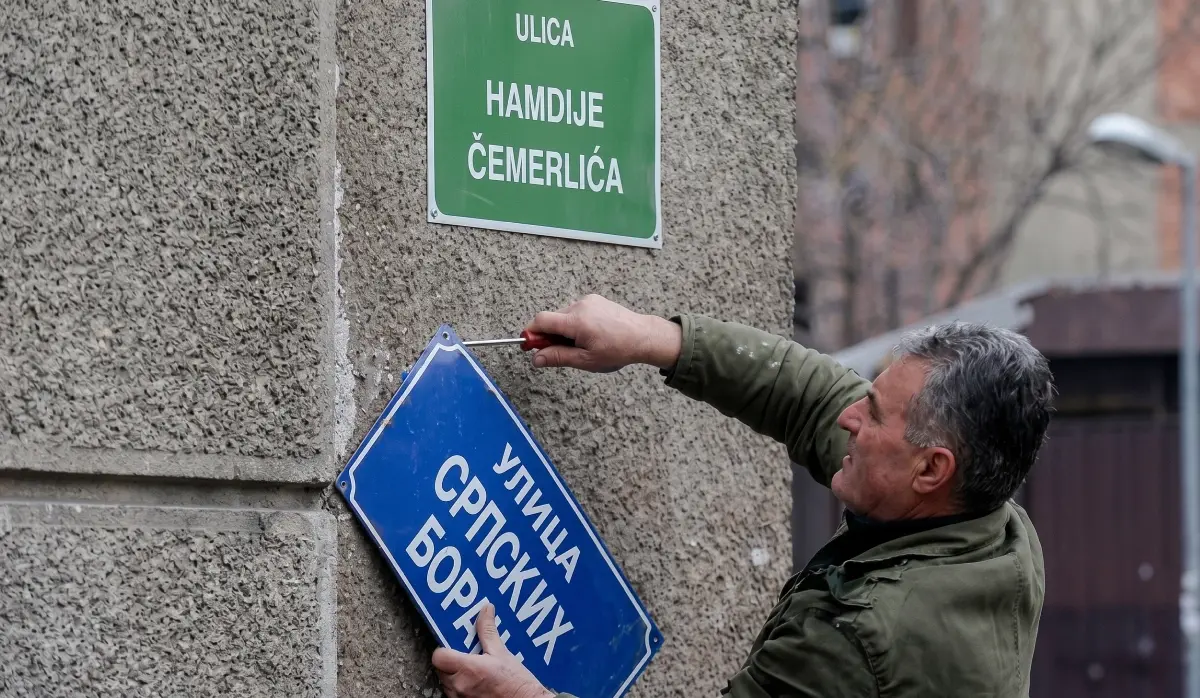
ISTOČNO SARAJEVO, MAY 16 /SRNA/ - The hypocrisy of Sarajevo politics is best reflected in the changing of street names in Sarajevo, through which there is an attempt to erase traces of Serb presence in the city, historian Aleksandar Kostović told SRNA.
As one example, Kostović cited November 6, 1918, the Day of the Liberation of Sarajevo in the First World War, when the Serbian liberation army was welcomed with enthusiasm by all residents of the city, and historical sources have preserved moving speeches by the head of the Islamic community and political representatives of Bosnian Muslims.
“In remembrance of that event, Sarajevo had a 6th November Street, Živan Ranković Square, the first Serbian soldier to enter Sarajevo, and Vojvode Stepe Stepanovića Embankment, which symbolically marked the route along which Serbian troops entered the city,” Kostović stated.
Kostović said that the square below Bistrik, formed at the beginning of the 20th century with the construction of Austro-Hungarian military buildings on both sides, and initially named Military Square, was renamed Ranković Square on January 10, 1919.
“After the Second World War, it was renamed April 6 Square, after a new liberation, and in 1993 it received the name Austrian Square, which it still bears today. Those who gave it that name are thereby concealing, but not erasing, both November 6 and April 6,” Kostović stated.
Kostović also said that Bistrik Street, which runs from the Miljacka River past the former Ranković Square up to the top of the Bistrica stream, kept that name until 1931, when it was renamed after November 6, the Day of Sarajevo’s liberation.
NO TRACE THAT THE NATIONAL THEATER WAS ONCE CALLED THE KING PETER II THEATER
Kostović said that today there are not even a tenth of the other landmarks that once testified to the presence of Serbs in Sarajevo, and that in the current “official” version of history, certain periods are being deliberately omitted from institutional and historical records.
“So we have an example that on the official website of the Sarajevo theatre, there is no trace that for years it was called the Theatre of King Peter II” Kostović stated.
Kostović assessed that by concealing part of its history, Sarajevo gains nothing.
“By these moves of hiding history, Sarajevo gains nothing except for short-term, cheap political points for individuals, while as a capital city, it loses a great deal. Legitimacy above all,” Kostović said.
TRACES OF A PEOPLE ARE BEING PUSHED OUT OF THE URBAN FABRIC
Sociologist Vladimir Vasić assessed that the process of renaming streets and reinterpreting public space in Sarajevo is not a neutral administrative act, but a clear message about who has the right to memory and visibility in society.
“When traces of one people are being pushed out of the urban fabric, that is rightfully perceived as symbolic marginalization, not merely a technical change. Sarajevo today shows how the politics of memory can become a tool for narrowing, instead of expanding, a shared identity. Examples such as Marijin Dvor, Hotel Evropa, or Baščaršija remind us that this city has historically been layered and multifaceted - and precisely that should not be reduced to a single dominant narrative,” Vasić told SRNA.
If public space is shaped in a way that reflects only one identity narrative, Vasić adds, then a community is not being built, but existing divisions are being deepened.
“A society that erases the complexity of its own past risks losing its ability to build a shared future,” Vasić believes.