VIPOTNIK: UNIVERSITY CITY - THE MOST SIGNIFICANT PARK AREA IN BANJALUKA
Republika Srpska - protected areas
07/11/2026
12:44

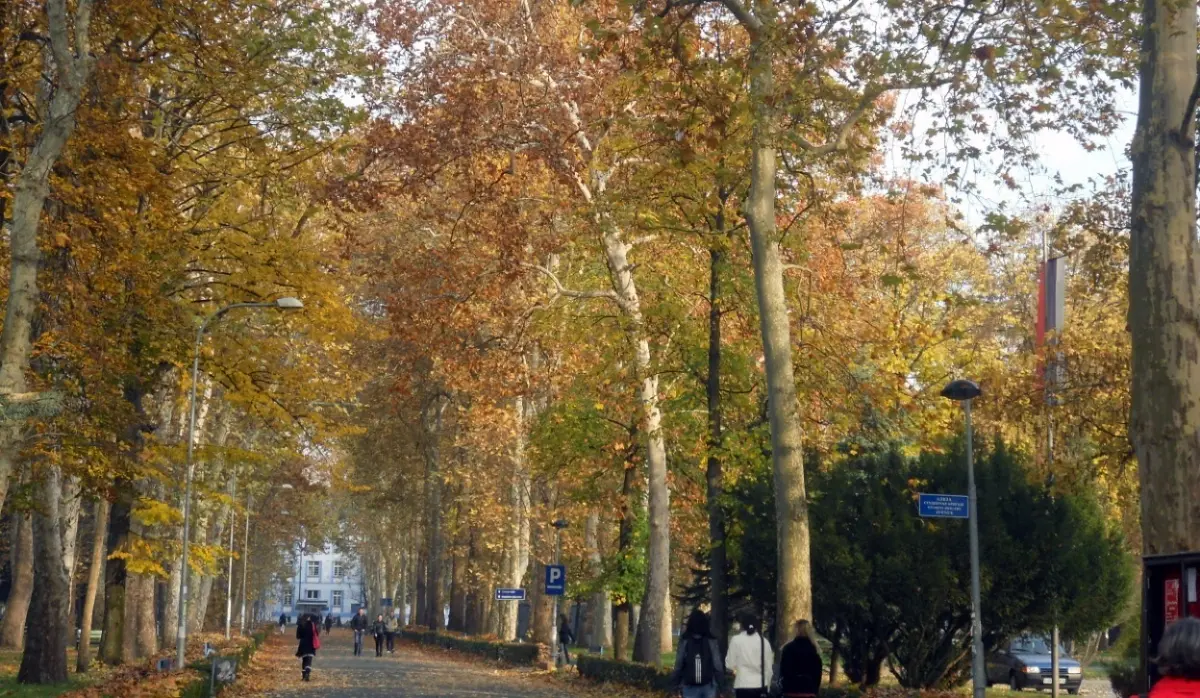
BANJA LUKA, JULY 11 /SRNA/ - University City is the most significant park area in Banjaluka, and over the past ten years, since it was declared a protected area, new gardens and architectural features have been systematically introduced, increasing the attractiveness of the complex, Republika Srpska Minister for Spatial Planning, Construction and Ecology Bojan Vipotnik told SRNA.
"Due to its rich dendroflora and ornithofauna, landscape attractiveness, ecological function, cultural and historical values, as well as its educational significance, it was declared a protected area in 2016 under the name Monument of Park Architecture 'University City'," Vipotnik explained.
Since its establishment during the Austro-Hungarian period, the complex had been hidden from the public due to its military purpose, which it retained until 2004, Vipotnik said. It was only after being given a civilian function that it opened up with all of its natural and man-made potential.
Due to the richness of its dendroflora, planted during different periods, and the fact that the Vrbas River, with its natural vegetation and bird fauna, forms the eastern boundary of the complex, it is certain that this is an exceptionally valuable ecological and landscape area in the centre of Banjaluka," Vipotnik said.
By becoming a university centre housing the Rectorate, faculties and student dormitories, the complex has also gained an important role in the life of Banjaluka, Vipotnik pointed out.
He stated that the controlled introduction of tree species of different heights, shrubs and flowering plants has significantly increased the landscape attractiveness of the complex.
"Taking into account the purpose and values of the complex, the goal of establishing protection is to create an arboretum by adding new species to already planted areas and a botanical garden in the area designated for that purpose," Vipotnik said.
According to him, the aim is to ensure adequate measures for the preservation of all values and the improvement of the complex, as well as to establish guidelines for its further development and restoration.
Vipotnik singled out the plane tree avenue stretching from the main gate of University City to the Rectorate building as a particularly valuable feature.
He noted that the tree avenue is approximately 270 metres long, runs along both sides of the pedestrian path and consists of 99 plane trees.
"The courtyard of the third pavilion of the 'Nikola Tesla' Student Centre covers an area of 4,540 square metres, and within this relatively small area there are 68 individual plants representing 27 different species. Although they are part of artificially created plantings, the presence of Serbian spruce and yew trees is particularly significant in this courtyard," Vipotnik specified.
He pointed out that the courtyard features the swamp cypress and a species of deciduous conifer originating from the shores of the Gulf of Mexico, which is not commonly found in urban environments.
"It is an exceptionally decorative species and represents one of the values of this park. From an aesthetic point of view, the Saucer magnolia and the Judas tree stand out," Vipotnik said.
He noted that within University City there are several impressive trees - remnants of the original vegetation - including a pedunculate oak, several narrow-leaved ash trees and elms, as well as a field maple, while willows can be found along the banks of the Vrbas River.
He said that the landscape value of the University City complex stems from the fact that it represents a green oasis within Banjaluka's urban fabric, while its attractiveness and functionality have gained importance since the change of purpose opened it up to visitors.
"The existing condition served as the basis for the preparation of project and technical documentation for the development of the complex, primarily as an arboretum and a botanical garden complex. Today, it is a true oasis of peace in the centre of Banjaluka, but also a serious scientific and educational resource, not only for students of natural and biotechnical sciences, but also for primary and secondary school pupils," Vipotnik said.
The University City Monument of Park Architecture is the only protected area within the territory of the city of Banjaluka, and it is managed by the Institute for Genetic Resources.


GOGANOVIĆ WITH ŠEKERINSKA: NATO EXPECTS SWIFT FORMATION OF GOVERNMENT, SNSD INDISPENSABLE PARTNER

US SENATORS BRIEFED ON DIFFICULT SITUATION OF SERBS IN KOSOVO AND METOHIJA

MINIĆ: NEW OPPORTUNITIES FOR PROJECTS WITH UNITED STATES ARE ENCOURAGING

NETFLIX TO BROADCAST WORLD CUP IN SPAIN