TULEKOVIĆ: MEMORIAL SITE DONJA GRADINA KEEPS ALIVE MEMORY OF USTASHA GENOCIDE VICTIMS
Serbia - Republika Srpska - culture of remembrance
11/17/2026
15:52

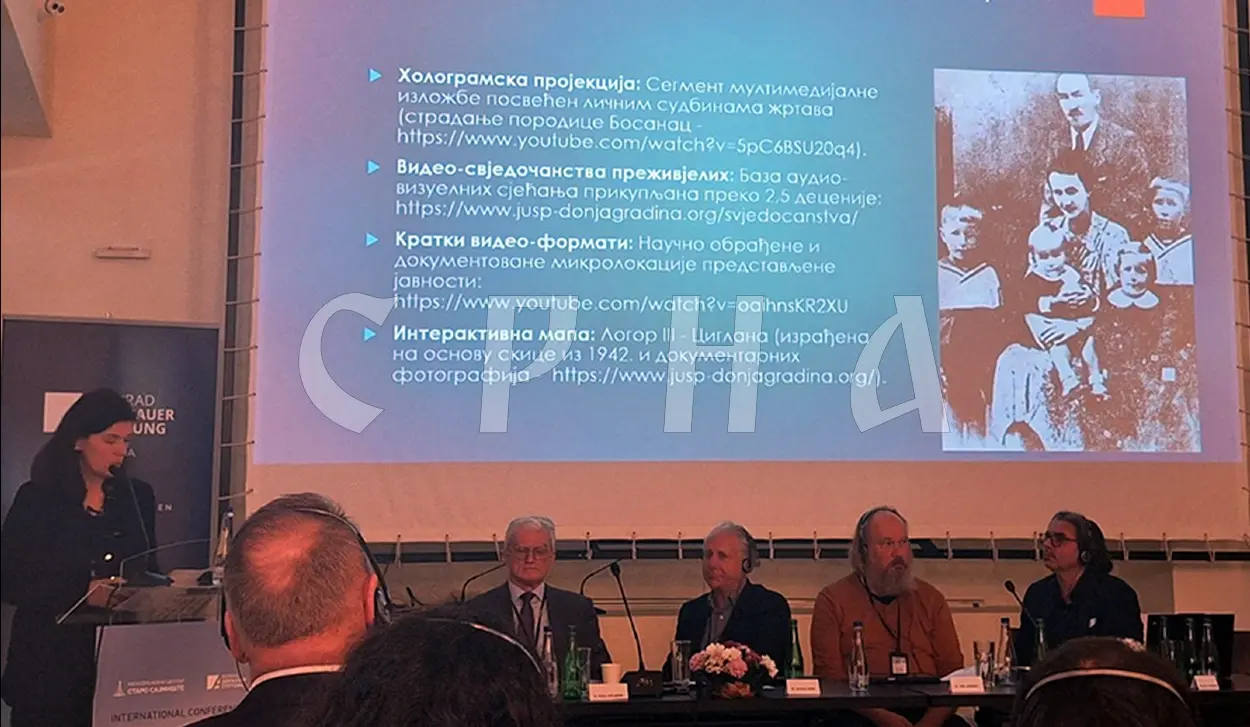
BELGRADE, NOVEMBER 17 /SRNA/ - Tanja Tuleković, director of the Donja Gradina Memorial Site, presented the Republika Srpska memorial complex today at the international conference "Remembrance for the Future" in Belgrade. She said the institution used a range of programs to preserve the memory of the victims of the Ustasha genocide.
Tuleković said representatives of the Donja Gradina Memorial Site had discussed future cooperation, the exchange of publications and participation in a round table to be held in Donja Gradina on April 22 next year with participants of the conference, which focuses on historical research into camps and killing sites in Yugoslavia and Europe.
She told SRNA that through various programs, research and modern digital technologies, the institution sought to pass on the historical truth to future generations and to research and present the material it had collected.
"Understanding the needs of modern society and taking care to balance traditional historiographical research with digitalization, we have adapted some programs to the digital world, such as a mobile app, animations and interactive maps. The goal, then, is education and preserving the truth from oblivion," she said.
She said memorial complexes were authentic places where history, collective memory and a society's identity came together.
"Society's need to preserve the past and pass historiographical facts on to future generations is reflected in the preservation and presentation of memorials as places for learning and for confronting historical facts responsibly," Tuleković said.
She said modern memorialization faced challenges such as choosing how to present historical facts to different age groups while keeping pace with the times and new museum methods.
She added that the Donja Gradina Memorial Site's participation was another in a series of joint activities with Belgrade's Staro Sajmište Memorial Center. These followed the signing of a cooperation agreement between the two institutions, which work on the culture of remembrance and on preserving the historical truth about the suffering of Serbs, Jews and Roma in the Independent State of Croatia /NDH/.
The two-day international conference "Remembrance for the Future," held at the Yugoslav Film Archive's State Audiovisual Archive, was organized by the Staro Sajmište Memorial Center and the Konrad Adenauer Foundation.
The conference brought together historians from Serbia and abroad, Holocaust researchers, experts on the culture of remembrance and memorialization, representatives of memorial institutions, museums, universities and institutes, as well as experts in digital technology and education.
Participants included the Technical University of Berlin, the Holocaust Memorial Center in Budapest, the Shoah Memorial in Paris and Ben-Gurion University of the Negev, as well as memorial and academic institutions from Serbia and the region.
Panel topics included historical research into camps and killing sites in Yugoslavia and Europe, current challenges in memorialization and preserving historical memory, and the opportunities and ethical challenges of using artificial intelligence and digitalization to present and research the past.
Particular attention was paid to education, young people and ways of passing on the culture of remembrance to future generations, as first-hand testimony from survivors grows increasingly rare and the challenges of historical revisionism become more pronounced.
Speakers also stressed the importance of sharing knowledge and experience on how to preserve historical facts, honor the memory of the victims with dignity and develop new approaches to the culture of remembrance in the 21st century.