STAMATOVIĆ: EVERYTHING OF OURS IN THAT SARAJEVO IS OLDER THAN YOURS
Republika Srpska - Istočno Novo Sarajevo - culture of remembrance
03/17/2026
07:15
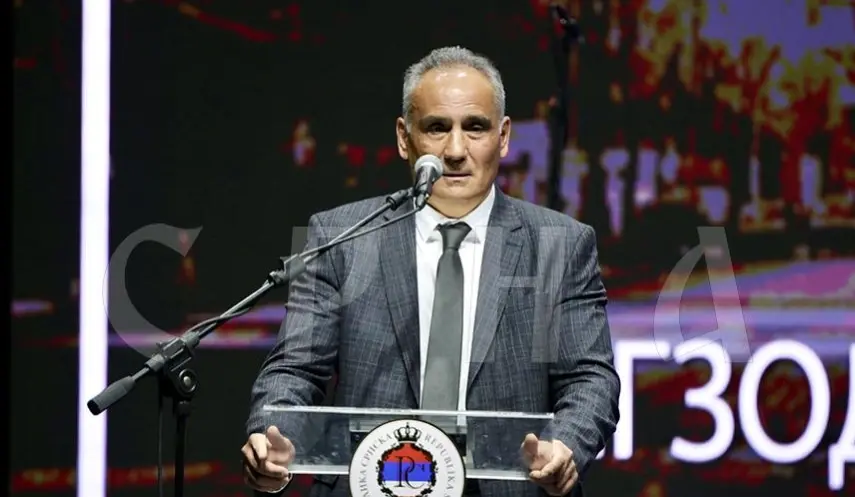
ISTOČNO NOVO SARAJEVO, MARCH 16 /SRNA/ - Aleksandar Stamatović, assistant professor at the Faculty of Philosophy of the University of Montenegro, sent a message this evening to political Sarajevo that “everything of ours in that Sarajevo is older than yours — the church at the top of Baščaršija, the stećci, the Cyrillic script, and Prosvjeta.”
Stamatović explained that the church at the top of Baščaršija, whose foundations were built in the time of the holy kings and emperors of the Nemanjić dynasty, dates from that period.
“It is older than your houses of worship. Our stećci are older, our Cyrillic script is older — the one you renamed bosančica through your Austro-Hungarian historians. Our story of European Sarajevo is older as well, and now everyone wants to go to Europe,” Stamatović said at a spiritual academy marking the 30th anniversary of the exodus of the Sarajevo Serbs.
He emphasized that the Serbian čaršija /traditional market quarter/ was the first embryo of European Sarajevo, stating that it was built with Serbian capital. The first theater in the Despić House was the work of Serbs; it did not come from Istanbul.
“Our Prosvjeta is older than your Gajret. Safet-beg Bašagić copied the entries from Prosvjeta to establish Gajret. The first hotel was built in 1882 with the Serbian capital of the Jaftanović family. That is Europe in Sarajevo that the Serbs brought,” Stamatović recalled.
In his address, he pointed out that there is a state unlike any other in the world, as the saying goes: “a house neither in the sky nor on the earth.”
“A state in which half of the people do not want to live in that state. History is relentless - after 35 years, the same dilemmas remain as in 1992,” Stamatović said.
Referring to statistics as the harsh discipline of history, he stated that according to the 1991 census, 157,000 Serbs lived in Sarajevo, along with 30,000 Yugoslavs.
“If we also take into account the syndrome of Serbian Yugoslavism, two-thirds of them were Serbs. The three municipalities of the Romanija region bring that number to 200,000 people. At the beginning of the war and during the war, around 2,000 distinguished Serbian intellectuals - academicians, university professors, specialist doctors, and lawyers - left Sarajevo,” Stamatović said.
He recalled that more than 4,000 people perished in various camps and execution sites, from Kazani to Silos.
“Political Sarajevo reduces everything to a populist notion of identity - the descendants of pashas, aghas, and beys ask: why did you leave Sarajevo? After Kazani, Silos, and 200 camps and execution sites, were we supposed to remain once again under your boot, your sword, or your rifle?” he asked.
He emphasized that the Sarajevo battlefield created Republika Srpska, and that the brave and martyred Sarajevo–Romanija Corps had 15,000 to 18,000 fighters in general mobilization, holding its ground against 40,000 Muslim fighters and “holy Allah’s warriors” from Iran and elsewhere who came to these areas.
He said that this corps held six municipalities that were taken away by the Dayton Agreement, and that the question of who is the victor and who is the defeated is very relative in history.