PLOTAN: HETEROGENEOUS EU LOST IN MULTIPOLAR WORLD
World - economy
03/16/2026
10:07
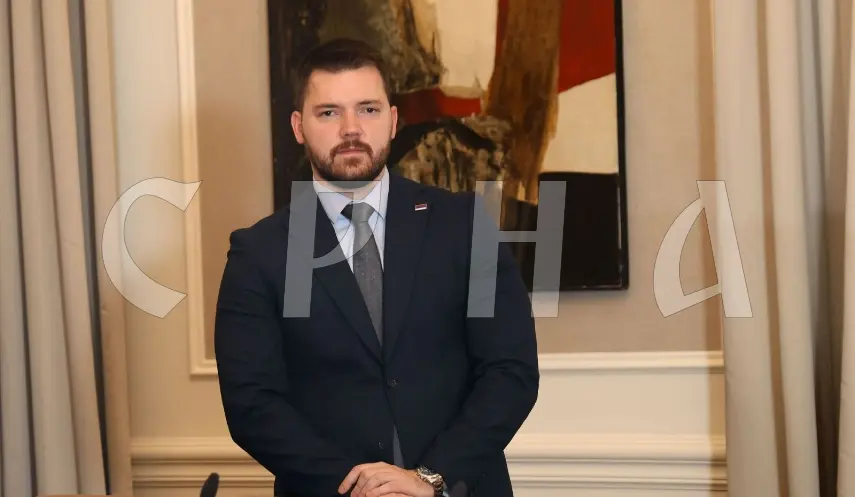
BANJA LUKA, MARCH 16 /SRNA/ - Although the idea of the European Union is essentially noble, the reckless policies that Brussels has pursued over the past few years have led the entire "European family" down a path of economic and political misdirection, international and economic policy expert Nemanja Plotan believes.
In a column for SRNA, which we are publishing in its entirety, Plotan stated that the 20th century was the bloodiest historical period for most of the world, which is why the victors, on two occasions - after the Great War and after World War II - established international institutions and norms aimed at preventing the repetition of similar episodes from the past.
The European Union originally began as an economic union, but its political goal was the stabilization of a continent that had produced both world conflicts.
Although the idea of the European Union is essentially noble, the reckless policies that Brussels has pursued over the past few years have led the entire "European family" down a path of economic and political misdirection.
The European economic model lost its competitiveness the moment Brussels chose an ideological approach to geopolitical questions instead of adapting to the new changes in the world by adhering to the postulates of structural realism.
However, the very structure of the EU reflects a fading world order "based on rules," characterized by multilateralism and international organizations.
Today, international organizations are facing a series of existential crises.
On January 7, 2026, US President Donald Trump signed a memorandum withdrawing the United States from 66 international organizations, which - considering that the US remains the military and political hegemon - is a clear indicator of the direction in which the world is heading.
The UN Security Council is no longer capable of resolving the crises affecting the world, and the international system has long entered a state of complete anarchy.
In such an anarchic environment, as economist and member of the British House of Lords Robert Skidelsky points out, Europe is trapped in a propaganda bubble of its own making, where the media and politicians live in a symbiosis of falsehoods: Russia is portrayed as the new Hitler seeking to conquer all of Europe, every diplomatic effort is labeled a Munich Agreement, and anyone who mentions Moscow's legitimate security concerns /such as those raised in 2014 or 2021/ is automatically branded a "Putinist".
This group psychology, first described by Sigmund Freud and later perfected by Edward Bernays and Joseph Goebbels, transforms rational analysis into moral hysteria. As a result, we have had four years of war without a single serious conversation between European leaders and the Russians—until Trump "broke the ice" and triggered panic in Brussels.
Reality, however, is brutal. The world is no longer unipolar, and Russia, China, India, and the Global South no longer accept the dictates of the "winners of the Cold War".
Multipolarity is not an ideology - it is a return to the classical balance of power, where every great power has its own interests and red lines. The EU, however, refuses to acknowledge this, and its leaders continue dreaming of a "European army" and renewed rearmament - but not against the real threat /the loss of the American security umbrella/, but against the imaginary "Russian march on Paris".
Europe has become a hole rather than a pole in the multipolar world - heterogeneous, divided, and incapable of speaking with one voice.
The latest proof of this disorientation came from the Middle East, where the military operation by the United States and Israel against Iran led to an explosive rise in oil prices.
In March 2026, Brent briefly surpassed USD 115 per barrel and, even after a correction, remained above USD 95 - the highest level since 2022. Europe, which imports more than 80 per cent of its energy resources, is once again on its knees. Inflation is rising, industry is shutting down, and citizens are paying ever higher bills.
The only quick and rational solution would be the lifting of sanctions on Russian energy resources - gas, oil, and coal. This would lower prices by 30–40 per cent, save the chemical and automotive industries, and give Brussels some breathing space. Instead, the EU insists on the "green transition" and "strategic autonomy" that it does not possess.
An even greater demonstration of Europe’s irrelevance lies in the negotiations to end the war in Ukraine. These talks are conducted directly between Russia, Ukraine, and the United States - with mediation by Trump's envoys such as Steve Witkoff - while European leaders are not even at the table.
There is no Emanuel Macron, no Olaf Scholz, no Ursula von der Leyen, and this is not accidental but rather a message: the EU is no longer a factor—it is merely a cost for America and an obstacle for Russia.
On the other hand, geopolitical shifts can be lightning-fast. Kirill Dmitriev, head of the Russian Direct Investment Fund and a key interlocutor of Trump, publicly presented the so-called "Dmitriev package" - an economic agreement worth between USD 12 and 14 trillion.
In exchange for lifting sanctions and peace in Ukraine, Russia is offering the United States joint projects in oil and gas, rare earths, nuclear energy, aviation, and a return to dollar-based settlements.
American companies have already lost more than $300 billion due to sanctions - Dmitriev argues that the package would be a "win-win". Volodymyr Zelenskyy described it as "USD 12 trillion for Ukraine". If Trump were to accept such an offer, Europe would remain "outside the game" - with sanctions that no one respects anymore, an industry in collapse, and without the American security umbrella.
A heterogeneous EU - with Poland preparing for war, Germany seeking business, Hungary seeking peace, and France seeking grandeur - is simply incapable of adapting to the new geopolitical dynamics.
While the world moves toward a multipolar balance, Brussels continues to live in 1991. If it does not wake up quickly - if it does not lift sanctions, stop the propaganda war, and accept that Russia is not "an evil that must be defeated," but rather a partner with whom negotiations are necessary - Europe will pay the highest price. Not only an economic one, but a strategic one as well, because in a multipolar world those who refuse to play by the rules of reality simply disappear from the map.