NO JUSTICE FOR PODRAVANJE SERB VICTIMS EVEN AFTER 34 YEARS
Republika Srpska - Srebrenica - culture of remembrance
09/24/2026
12:19
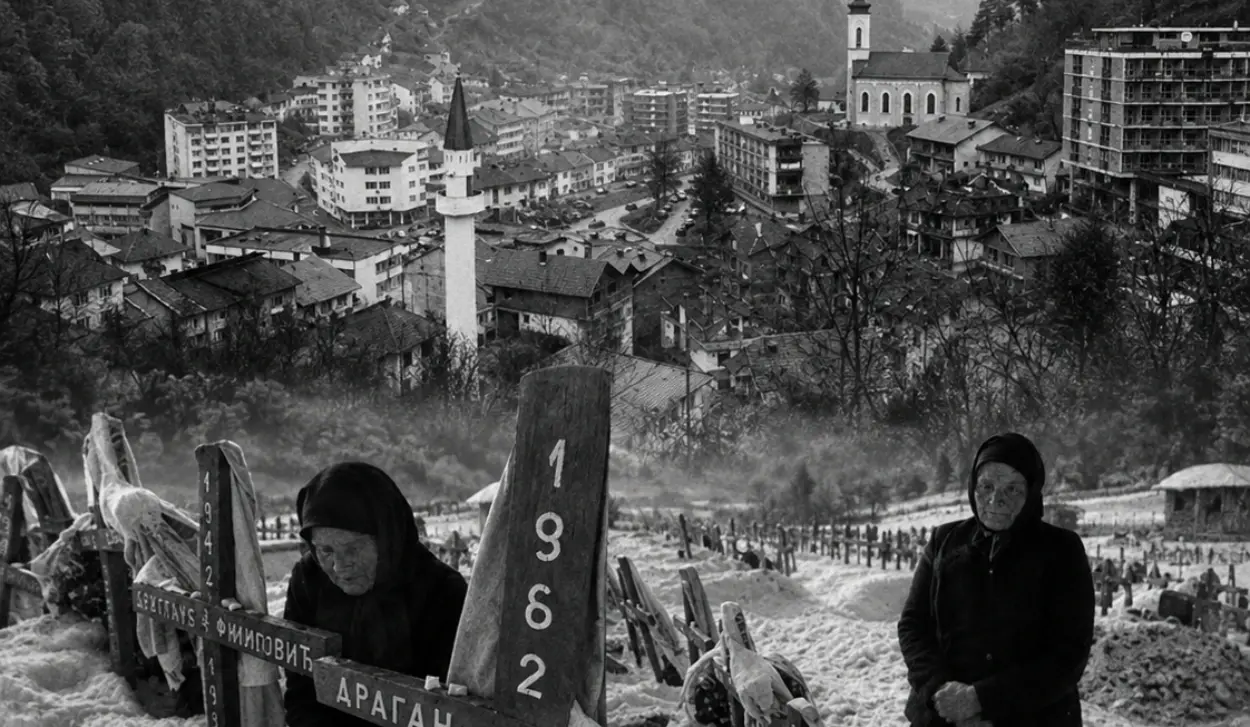
SREBRENICA, SEPTEMBER 24 /SRNA/ - A memorial service was held today at the Church of the Holy Great Martyr Marina in Podravanje near Srebrenica for 60 Serbs, this village residents, who were killed during the last war, including 32 civilians and soldiers who were killed today in 1992.
By attending the memorial service and lighting candles, several dozen residents, family members and comrades of the victims marked 34 years since the killing of Serbs from this village. Among them were eight members of the Perendić family, seven each from the Marinković and Šarac families, and four each from the Nikolić and Jovanović families.
Villagers recall the case of an elderly man, Drago Mitrović, who was slaughtered by Ustasha forces during the Second World War but survived and was left unable to speak.
During the recent war, he was again slaughtered. Witnesses who had been hiding said that the perpetrator knew him and told him before killing him that he had survived 1941, but that this time he certainly would not survive. The perpetrator then beheaded him.
Representatives of the Association of Veterans, the Veterans Association, the Organisation of Families of Captured, Fallen Soldiers and Missing Civilians, and the Municipality of Srebrenica laid flowers at the memorial plaque dedicated to those killed, which was placed on the wall of the church.
Miloš Milovanović, a representative of the Srebrenica War Veterans Association, said that a mass crime against Serbs had been committed in Podravanje 34 years ago and that neither the International Criminal Tribunal for the former Yugoslavia nor the judiciary of BiH had prosecuted anyone for the crime, which demonstrates the one-sidedness of the those courts and points to the injustice done to the Serb people.
He said that Serbs are hostages of the Prosecutor's Office and Court of BiH and that there can be neither freedom for the Serb people in BiH nor coexistence and reconciliation until perpetrators of crimes against Serbs are also convicted for their crimes, killings, mutilations and torture of Serb civilians.
Branimir Kojić, head of the Municipal Organisation of Families of Captured, Fallen Soldiers and Missing Civilians, said that today's commemoration honours all 60 Podravanje Serbs who were killed during the Defensive-Homeland War, while the memorial service marks 34 years since the suffering of the village and the deaths of 32 of its residents, half of whom were civilians.
"It is sad and shameful for the judiciary of BiH that no one has been held accountable for the crime against civilians in Podravanje. This shows the attitude of BiH and its judiciary toward the Serb people and Serb victims," Kojić said.
He said that the Podravanje crime contains all the elements of genocide, but that "three decades were not enough for the discriminatory Court of BiH to indict the perpetrators of the crimes in this village".
"We do not need such a judiciary. It is a destabilizing factor and creates dissatisfaction and distrust among the people. It causes frustration among the Serb population because no one is held accountable for crimes against Serb civilians and soldiers in Podrinje, while Muslim hordes killed more than 3,000 Serbs and destroyed everything with Serb prefix in order to erase traces of the existence of Serbs in this area," Kojić said.
Half of those killed in Podravanje were civilians - women, elderly people, children, the bedridden and the blind.
Today 34 years ago, large Muslim forces from Srebrenica and Žepa surrounded the scattered mountain village of Podravanje and its hamlets, cut off the only road connection at the time to Milići, and launched artillery - infantry attack.
Armed men put up resistance and the fighting lasted throughout the day. Thirty-two residents were killed, while in the evening a small number of survivors, including some who were lightly wounded, managed to break through the encirclement and escape alive.
A group of Serb soldiers from the village was completely surrounded and, while they still had communication with the responsible command, they requested that artillery fire be directed at them and kill them rather than allow them to fall alive into enemy hands. Fortunately, they held out until nightfall and survived after managing to escape thanks to their good knowledge of the terrain.
Milojka Bibić lost her brothers Rade and Milovan, her father Miloš and her mother Dikosava Marinković that day.
"Muslim soldiers surrounded and attacked the village from all sides, and then, amid indescribable shouting and cries of ‘Allahu Akbar,’ they entered the village and killed everyone they could reach," Milojka previously told SRNA, recalling the tragic day when she unsuccessfully tried to rescue her wounded brothers and parents from the encirclement.
According to her, Muslim soldiers were killing everyone indiscriminately - women, children and elderly people, as if they knew they would never be held accountable, “but there is also God's punishment, if the Hague Tribunal and the judiciary of BiH are unwilling to prosecute them”.
She stressed that the attitude of the international and BiH judicial systems was shameful, claiming that they prosecute only Serbs, while no one has been held accountable for her family members who were killed in their own village simply because they were Serbs, and that there has been no justice even after 34 years since the crime and 31 years since the end of the war.
Seven women were among those killed in Podravanje.
Cvijetin Šarac previously said that his 30-year-old son Mitar was killed near their home on that tragic day. His uncle Veselin was also captured; he survived horrific torture and abuse and died shortly after being exchanged as a result of the beatings. His ribs and jaw had been broken and all of his teeth had been knocked out.
Dragutin Šarac previously told SRNA that his brother Veselin had told him that Naser Orić personally beat him in the prison camp. He knew Orić because he had attended school with Veselin's son.
All 120 houses and other commercial and auxiliary buildings in Podravanje were burned down that day, after all Serb-owned property had first been looted.
As a memorial to the residents and relatives who were killed, the surviving Podravanje residents built a church where they hold religious services and memorial services for the victims. In their memory and as a sign of gratitude, memorial plaques bearing their names were placed on the church wall.