MIRACULOUS SAVING OF THE ČAJNIČE KRASNICA
Republika Srpska - Foča - SOC
01/23/2026
12:21
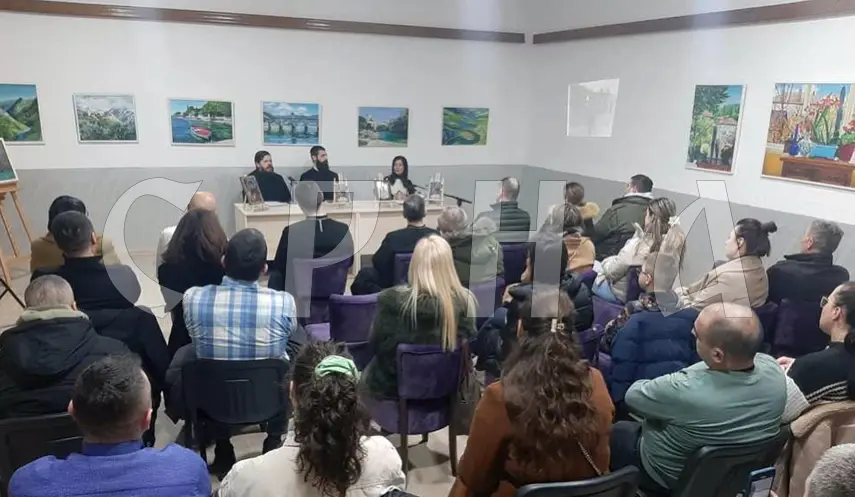
FOČA, January 23 /SRNA/ - The people of the Čajniče, Pljevlja and Foča regions miraculously preserved the Čajniče Krasnica - the wonder-working icon of the Most Holy Mother of God, during the most difficult times of World War II, firmly believing that by protecting this great holy relic they were protecting themselves and their families, it was said at a spiritual evening held in Foča.
The Čajniče Krasnica, which King Milutin Nemanjić brought from Jerusalem to Serbia and donated to the Monastery of Banja near Priboj, was transferred to Čajniče after the Ottoman conquest, where for centuries it has spiritually strengthened the faithful and miraculously healed not only Orthodox Christians, but also Muslims, Catholics and all who approach it sincerely and with strong faith.
There are many examples of miraculous healings, some of which were shared by Archpriest Dragiša Simić at the spiritual evening organized by the Foča Center for Culture and Information.
The head priest of the Church of the Dormition of the Most Holy Mother of God in Čajniče recounted that several years ago oil from the vigil lamp in front of the Čajniče Krasnica helped a man from Pale who suffered from a serious problem with his leg, which was changing color, while visits to doctors brought no improvement.
"He began anointing his leg with the oil, and gradually it started returning to its normal, healthy color. The health problem was completely resolved after anointing with the oil from the icon of the Most Holy Mother of God," Simić emphasized.
It is well known that the Čajniče Krasnica helps married couples who are unable to have children. Archpriest Simić recounted the case of a married couple from Kruševac who could not have children for several years until they came to Čajniče to pray before the Krasnica for offspring.
"While sleeping in the guesthouse next to the church, the woman dreamed of two little boys playing in the churchyard, and she asked herself in the dream, `God, whose children are these?` From a great light she heard the voice of the Most Holy Mother of God saying, `These are your children.` Later, she gave birth to twin boys, exactly as she had dreamed," the Čajniče parish priest conveyed one of many stories told by Serbian mothers.
During the Second World War, after Italian occupying forces mined two churches in Čajniče on the night between April 11 and 12, 1943, the Krasnica miraculously remained undamaged in the explosion.
With the blessing of Čajniče Archpriest Jovan Jovanović, its wartime journey then began. A major role in saving the icon was also played by a Muslim from Čajniče, Vehbija Ćehajić, who warned the priest in advance to hide the icon because the Ustasha "Devil's Division" was approaching.
Deacon of the Church of the Dormition of the Most Holy Mother of God in Čajniče, Uglješa Skoko, one of the authors of the book "The Journey of the Icon of the Čajniče Krasnica During World War II," stated that this holy relic was hidden for three and a half years in caves and small churches in the municipalities of Čajniče, Pljevlja and Foča.
"It was a long and dangerous wartime journey, and the greatest contribution to preserving the icon was made by the Popović and Mašić brotherhoods, who were ready to sacrifice their lives to protect it," Skoko said.
He added that although there were opportunities to take the icon to Belgrade for safekeeping until the end of the war, they did not allow it.
"The people of Čajniče took that responsibility upon themselves, and so it was. Throughout their lives they said that they did not protect the icon, but that the icon protected them and their families all that time. It still protects and safeguards us all today," Skoko said.
This wonder-working icon was kept the longest in the Trpinje Cave near Čajniče, for a total of three years, until March 1946, when it was returned to the Church of the Dormition of the Most Holy Mother of God.
Previously, in September 1943, it was also kept in the municipality of Pljevlja, in the village of Strečanje, and later in the municipality of Foča, specifically in Foča's Slatina, in the Church of Saints Constantine and Helena at Okolišta.
From that church, it was transferred to the nearby Zlataja Cave, and then to the Slatina hamlet of Bać, where it was hidden inside a large beech tree.
According to the testimony of the late Đoka and Mileva Đorđević from Bać, as told to the book’s author by their daughter Fima Vilotić, during those days a fire engulfed the entire forest and surrounding area, but the tree in which the icon was hidden remained untouched.
At that time, the icon was guarded by the Đorđević, Vilotić, Radović, Pljevaljčić, Mihajlović and Ivanović families.
The end of the war found the icon in a cave high in the cliffs above the Čajniče village of Trpinje, where local residents guarded it day and night in shifts. After the war, the cave fell into neglect until about ten years ago, when a group of young men from Čajniče, including Deacon Uglješa Skoko, decided to restore it and turn it into a chapel.
After arranging the access path, they excavated a large amount of earth from the cave to allow upright movement, built a holy altar, and paved the floor with stone slabs.
With the blessing of His Eminence Metropolitan of Dabar-Bosnia Hrizostom, the cave in which the Popović and Mašić brotherhoods protected the Čajniče Krasnica for three years during World War II officially became the Chapel of the Mother of God in 2021.