MARKING THIRTY YEARS OF SERBIAN LANGUAGE AND LITERATURE STUDIES
Republika Srpska - Istočno Sarajevo - Faculty of Philosophy
04/03/2026
16:04
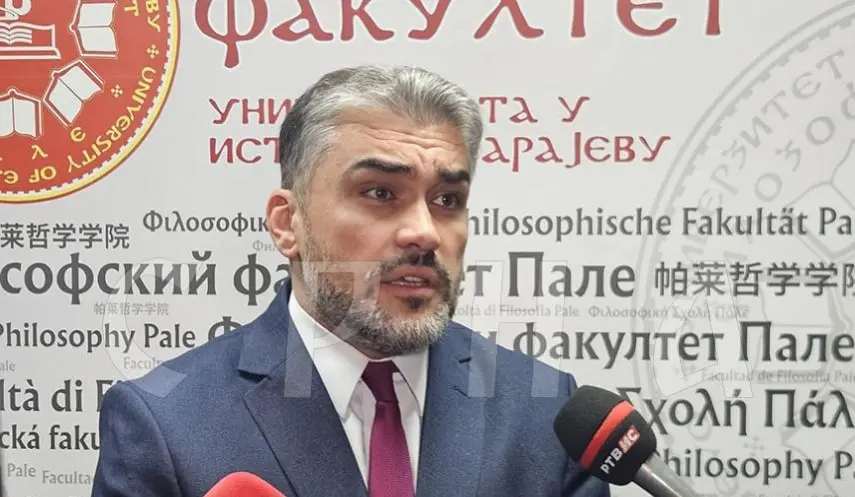
PALE, APRIL 3 /SRNA/ – Three decades of the Serbian Language and Literature study program at the Faculty of Philosophy of the Istočno Sarajevo University were marked today in Pale, with receptions held for students of the first and second generations, along with lectures delivered by their former professors.
Dean of the Faculty of Philosophy of the Istočno Sarajevo University Vladan Bartula said these were generations of students who enrolled in the academic years 1993/1994 and 1994/1995, when the newly established Faculty offered this study program alongside Pedagogy with Psychology.
One of the first professors in the Serbian Language and Literature program, Professor Miloš Kovačević, emphasized that the department was founded as a sign of defending national identity criteria.
According to him, it was a time when the language and the people were divided, when the Serbo-Croatian language no longer existed.
"The Faculty of Philosophy in Istočno Sarajevo was established to demonstrate that studying the Serbian language at this faculty essentially means preserving Serbian identity in BiH, that is, in Republika Srpska," Kovačević stressed.
Kovačević assessed that the first generations had a special status, as national interests were discussed more than ever before.
He reminded that, along with him, pre-war professors of the Faculty of Philosophy in Sarajevo - Ljubomir Zuković, then Minister of Education of Republika Srpska, and Vojislav Maksimović, who was the rector of the University of Istočno Sarajevo - participated in founding the faculty.
The first generations attended classes during wartime at the Faculty of Electrical Engineering in Lukavica (in Istočno Novo Sarajevo), and both students and professors went several times to nearby front lines to defend the faculty.
"That generation experienced how national interests were implemented in wartime conditions both in the classroom and in practice," Kovačević said.
Head of the Department of Serbian Studies Biljana Samardžić stated that the first generations of students of Serbian studies and psychology were in fact the first students of the Faculty of Philosophy in Istočno Sarajevo, which has since grown from two study programs to as many as 16.
"They were the founders of our faculty and department back in that distant wartime year of 1994," Samardžić said.
Branislava Obućina, one of the first-generation students of Serbian language and literature, pointed out that for her and her colleagues, studying and going to university during those war years was a parallel world they escaped to from a harsh reality.
“This is an opportunity for us to see each other. There are not many of us from the first generation, eight or nine, and some of us haven’t seen each other for more than 20 years since graduation,” Obućina said.
Dejan Kerleta, a member of the second generation of Serbian language and literature students, said that going to classes in Lukavica during wartime, when the territory of what was then Serb Sarajevo was exposed to severe attacks and sniper fire, was uncertain and students often could not reach the faculty.
"The conditions were very difficult. Now when we talk about it, we ask ourselves whether we were normal to study in such conditions, without electricity or heating," Kerleta noted.