MARKING THE 83RD ANNIVERSARY OF THE BATTLE OF SUTJESKA
Republika Srpska - historical events - annauncement
06/14/2026
11:10
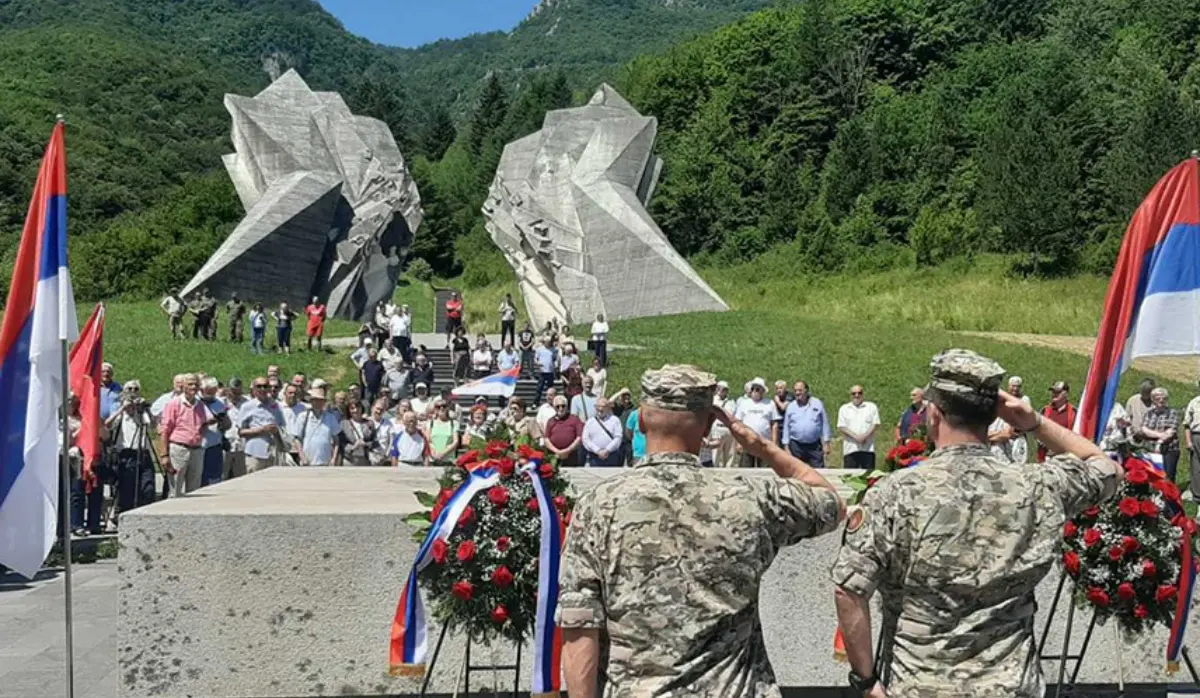
BANJA LUKA, JUNE 14 /SRNA/ – The 83rd anniversary of the Battle of Sutjeska will be marked today at Tjentište.
The programme will begin at 11:00 a.m. with the laying of wreaths and flowers at the Memorial Ossuary, while speeches by officials and a cultural programme at the Memorial House are scheduled for 11:30 a.m., announced the Ministry of Labour, War Veterans and Disabled Persons Protection of Republika Srpska.
The event will be attended by Minister of Energy and Mining Petar Đokić.
The marking of this historical event of republican significance honours the memory of the major battles fought by Partisan units against German forces, which were supported by Italian, Bulgarian, and Ustasha-Home Guard units.
The Battle of Sutjeska, also known as the Fifth Enemy Offensive, was the name given to Operation Schwarz, conducted by German forces in the summer of 1943.
The operation was launched with the aim of destroying the Partisan resistance movement of the National Liberation Army and disarming and neutralizing the Yugoslav Army in the Homeland.
On May 6, 1943, General Rudolf Lüters, commander of German forces in Croatia, issued an order for the preparation and execution of Operation Schwarz with the objective of eliminating the Partisan movement.
A total of 127,000 troops were deployed for the encirclement and destruction of Partisan units in the Sutjeska, Piva, and Tara region.
Surrounded by the forces of Nazi Germany, Italy, Bulgaria, and the Independent State of Croatia were 22,148 Partisans. The Battle of Sutjeska began on May 15.
After a month of fierce fighting, it ended on June 15. Despite enormous Partisan losses -7,454 Partisans were killed, including 6,946 men and 597 women - the majority of the units managed to break out of the encirclement.
As a result, the Battle of Sutjeska became a symbol of extraordinary sacrifice, courage, and moral steadfastness in the face of the greatest hardships. In post-war Yugoslavia, numerous streets, schools, institutions, and sports clubs were named after the battle.
In terms of both scale and the number of soldiers killed, this was undoubtedly the largest military operation conducted on the territory of Yugoslavia up to that time.
One of the organisers of the uprising in the Nikšić region, Sava Kovačević, was killed on June 13, 1943, while leading an assault during an attempt to break through the German encirclement near the village of Vrbnica, close to Foča.
Killed alongside him in the assault were his father, brother, and his underage nephew Dragan, who served as his courier. He was proclaimed a National Hero of Yugoslavia on July 6, 1943.
In May 1943, Kovačević was promoted to the rank of colonel in the National Liberation Army of Yugoslavia /NOVJ/, while during the Battle of Sutjeska, in June 1943, he was appointed commander of the Third Assault Division