KARAN: TWO TO THREE PATERNITY TESTS WEEKLY
Republika Srpska - Forensic Medicine Institute
11/18/2026
09:29

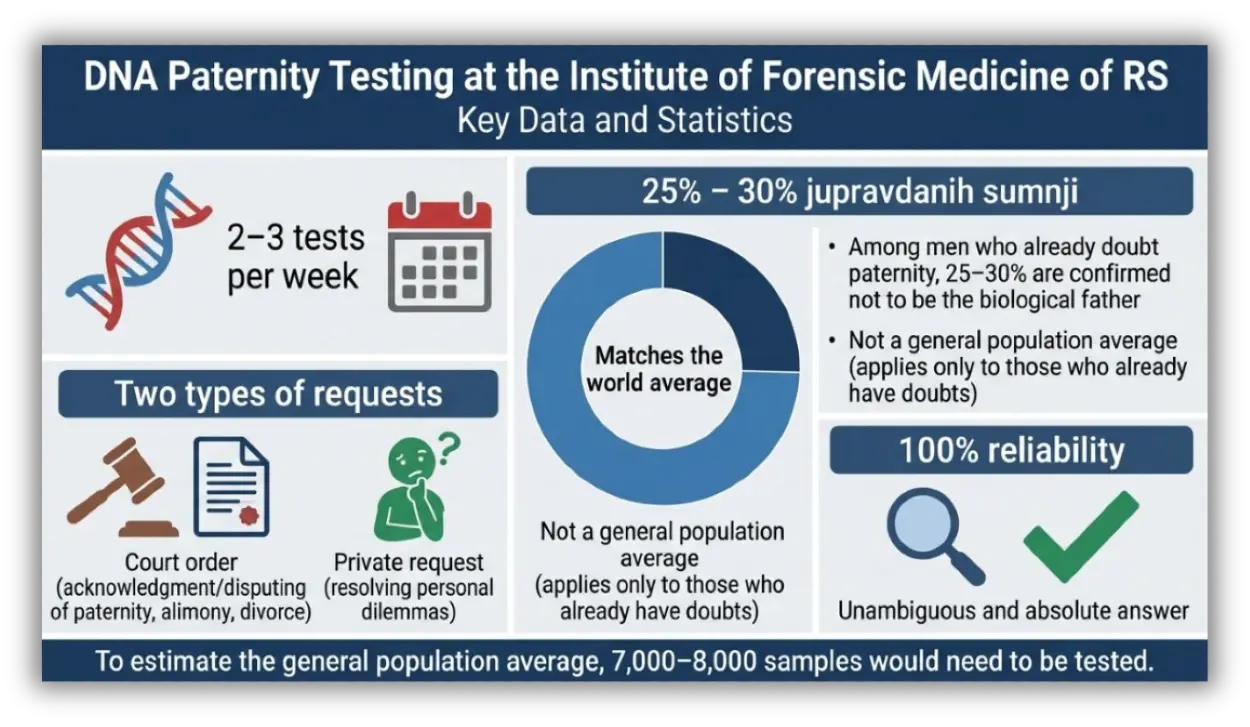
BANJA LUKA, NOVEMBER 18 /SRNA/ – The Republika Srpska Institute of Forensic Medicine conducts two to three DNA tests per week to establish paternity, and in 25 to 30 per cent of cases, suspicions prove to be justified, said Željko Karan, Director of the Institute.
He stressed that it should be borne in mind that this percentage does not represent the general population average, but applies exclusively to individuals who already have a specific reason to question paternity.
Karan explained that the Institute's DNA testing covers two areas: forensic analysis of biological traces collected at crime scenes and testing to establish paternity.
"First, we conduct forensic analyses, processing all biological samples containing DNA, whether they are reference samples collected here in the laboratory or samples submitted from the field, such as traces found at crime scenes," Karan explained.
Speaking about paternity testing, Karan noted that requests are received both through court orders and private applications from citizens.
"Court-ordered tests are most commonly related to proceedings involving the establishment or contesting of paternity, child support and divorce cases," Karan said, adding that citizens also frequently approach the Institute on their own initiative, without any court proceedings, in order to resolve personal doubts.
Unlike earlier methods, which could exclude paternity only with a certain degree of probability, DNA analysis provides a definitive answer.
"DNA analysis will absolutely and unequivocally show whether or not a particular person is the biological father of a child," Karan emphasized.
Karan warned against misinterpreting statistics concerning the number of negative paternity test results.
"We are in line with the global average. Among those who have doubts, their suspicions prove justified in 25 to 30 per cent of cases. However, it is not true that 30 per cent of fathers are not the biological fathers. This is not a general population average, but rather the percentage among people who already have a reason to suspect paternity and come to us to confirm or disprove their suspicions," Karan explained.
He noted that establishing a general population average would require testing several thousand families, or between 7,000 and 8,000 individual samples, which would provide a more reliable statistical assessment.
"In the course of our work, the Institute has also encountered unusual life situations, such as the case of a 90-year-old man who wanted to establish whether his daughter, then in her sixties, was indeed his biological child, so that he could `die in peace,`" Karan said.