HOW HIGH REPRESENTATIVES UNDERMINE REPUBLIKA SRPSKA'S ECONOMY
Republika Srpska - economy - Plotan
12/01/2025
10:04
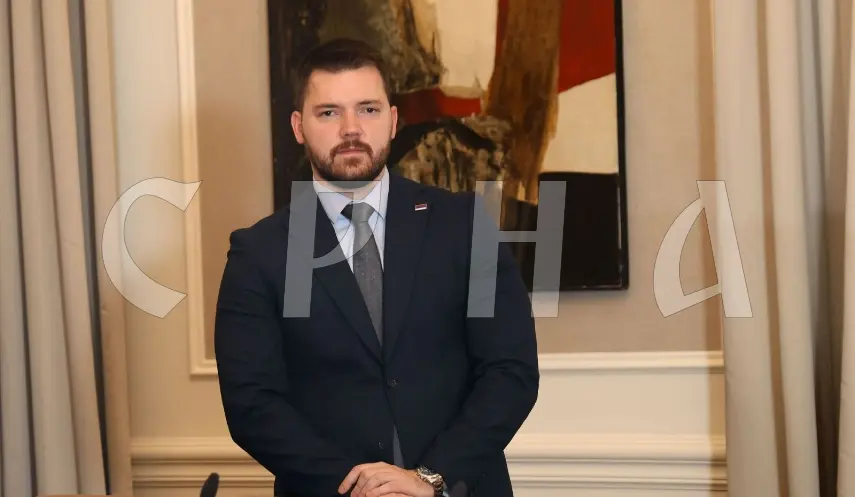
BANJA LUKA, DECEMBER 1 /SRNA/ - When looking at the entire time horizon from 1996 to the present, the pattern indicates that every time high representatives impose decisions that change political relations in BiH, the political stability index suffers significantly, international and economic policy expert Nemanja Plotan assessed.
Plotan emphasized that this means that the market, i.e. investors, institutions and international actors, always negatively assess this type of political shock.
"These values are not just an abstract statistical indicator, but direct information to investors that BiH is a politically high-risk area and that it is not a good place to invest. In that way, the high representative, with his imposed decisions, affects GDP growth, because he indirectly blocks the inflow of foreign direct investment," Plotan explained in a column for SRNA.
SRNA publishes Nemanja Plotan's column in its entirety:
GDP is by definition a macroeconomic indicator that reflects the value of all final goods and services produced in a country during a given year. It is calculated as the sum of domestic consumption, investment, government spending, and the difference between exports and imports.
However, in the case of BiH, there is an additional factor that must be considered when calculating GDP: the role of the illegitimate High Representative.
Within the structure of BiH's GDP, domestic consumption plays a dominant role which, together with government spending and investment, accounts for roughly 85 to 90 percent of total economic activity - a pattern typical of small, import-dependent economies.
An annual GDP growth rate of around 2.9 percent is moderate, but it clearly signals structural constraints, such as small and fragmented markets, slow economic growth in the region, and insufficient investment in productive sectors.
This is, among other things, characteristic of a post-conflict society. Such societies have not yet freed themselves politically from the burdens of the past, which generates a poor economic environment.
Capital flows primarily into low-risk sectors that offer quick returns, such as trade and real estate, while industry, exports, and technology develop slowly. In the long run, the GDP of Republika Srpska - and of the entire BiH - suffers because BiH is not economically competitive on the international market.
However, the permanent political crisis generated by the illegitimate High Representative creates a negative image of Republika Srpska and BiH globally, sending a troubling signal to foreign investors. When selecting a country in which to invest capital, foreign investors closely observe the political stability index.
The World Bank defines its Political Stability Index, officially named "Political Stability and Absence of Violence/Terrorism," as a measure of the perceived likelihood of political instability and politically motivated violence.
The index ranges from -2.5 to +2.5, where negative values indicate higher risk, instability, and/or a greater likelihood of violence or terrorism, while positive values indicate relative stability and lower risk.
In BiH's case, this value has always been negative, especially when compared to other former Yugoslav states, which record positive values. Given that BiH's economy is very similar to the economies of these states, this is already a clear indication of a strong correlation between the country's political structure and its negative political stability ratings.
Furthermore, when analyzing individual years and specific political events, it becomes clear that the deepest declines in political stability are directly linked to crises triggered by the High Representative through the imposition of decisions.
The clearest example is from 2011, when the imposition of decisions regarding state property produced one of the most severe institutional crises in BiH's post-Dayton history. That same year, the political stability index recorded its lowest value ever - approximately -0.82 - indicating an extremely negative perception of political security and risk.
The index improved in the following years, largely due to an absence of new imposed decisions.
However, the self-proclaimed High Representative Christian Schmidt's imposition of criminal code amendments in 2021, after a long period without interventions, again led to a high degree of institutional blockage and escalating political tensions.
This contributed to a further decline in political stability, which was only deepened by the most recent crisis in June 2023, when the National Assembly of Republic of Srpska adopted a law on the non-implementation of decisions of the High Representative, in response to the requirement that such decisions be published in the Official Gazette of Republika Srpska.
When examining the entire period from 1996 to today, the pattern shows that each time the High Representative imposes a decision that alters political relations in BiH, the political stability index deteriorates significantly.
This means that the market - investors, institutions, and international actors - consistently perceives such political shocks as negative. These values are not merely abstract statistical indicators, but direct signals to investors that Bosnia and Herzegovina is a high-risk political environment and not a favorable destination for investment.
Thus, the High Representative, with his imposed decisions, affect GDP growth because they indirectly obstruct the inflow of foreign direct investment.
A comparison between BiH and other former Yugoslav states further reinforces this argument. Serbia, Croatia, Montenegro, and North Macedonia - all of which share similar economic structures and a common transition legacy - attract significantly higher levels of foreign direct investment than BiH.
While Serbia attracts between 7 and 8 percent of GDP annually through foreign investment, and Croatia - after joining the European Union - achieves a stable inflow of roughly 6 to 8 percent of GDP, BiH remains at only 2 to 3 percent. Even the smallest economies in the region, such as Montenegro and North Macedonia, attract proportionally more capital due to greater political predictability and lower institutional fragmentation.
According to data published by the Central Bank of BiH, foreign direct investment inflows in 2024 amounted to BAM 1.76 billion, which is BAM 301.2 million less than in 2023, when they reached BAM 2.06 billion.
This trend is unsurprising when considering the political crises caused by the illegitimate High Representative Christian Schmidt through his imposed decisions in recent years.
These are clear indicators that economic prosperity throughout BiH is possible only through the abolition of the Office of the High Representative, as each imposed decision by a foreign bureaucrat costs citizens several hundred million BAM annually.