ANDRIĆ'S VIEW - BRINGING TOGETHER NOBEL LAUREATE'S LITERARY WORK AND HREŠA LANDSCAPE
Republika Srpska - Ivo Andrić - Cultural and Historical Complex /2/
10/07/2026
09:53

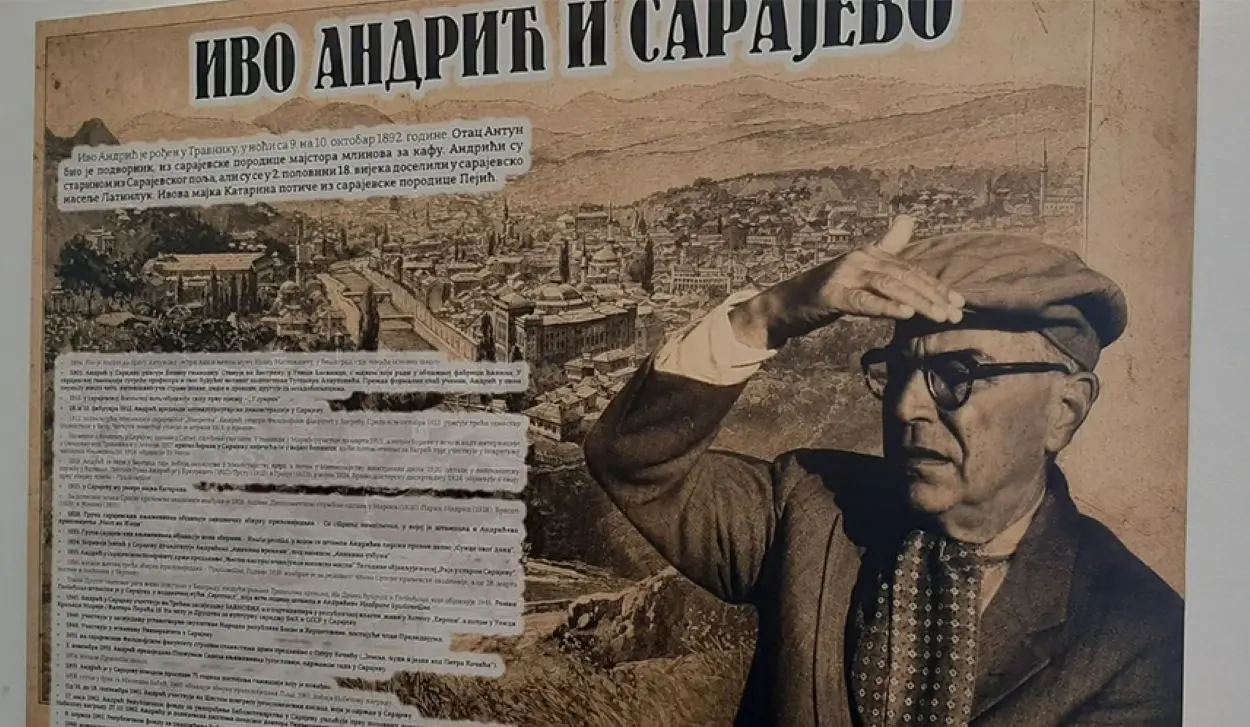
ISTOČNO SARAJEVO, OCTOBER 7 /SRNA/ - By building a cultural and historical complex in honour of Ivo Andrić, Istočni Stari Grad and Istočno Sarajevo are building a bridge that will permanently connect people through culture and create a venue for international gatherings for generations to come.
By Željka Domazet
The future complex, featuring a monument to Andrić at Hreša and the Andrić Trails on Trebević, will stand as a lasting testimony that the writer's visions of bringing people, cultures and nature together are a profound need of our contemporary world, creating an invaluable new bridge that will permanently connect this area with the highest values of European and world heritage.
Bojo Gašanović, Mayor of Istočni Stari Grad, told SRNA that the entire complex will probably be named Andrić's View, but that he would entrust the final decision to the Honorary Committee.
Gašanović explained that the choice of Hreša and Trebević was not accidental.
"At the initiative of university professors from Istočno Sarajevo and Belgrade, we launched a project that brings together Andrić's literary work, his biography and this unique setting. Here, Andrić's famous view from Trebević, captured in a photograph from 1961, naturally meets his writings about the sun's crimson glow over Hreša," Gašanović said.
He noted that academician Matija Bećković is chairman of the Committee for the Construction of the Cultural and Historical Complex.
"It is with particular pleasure and pride that I emphasize that we have formed the Honorary Committee for the construction of this cultural and historical complex and that Academician Bećković is its chairman. His support for the project gives it special significance and symbolism," he said.
Gašanović stressed that the goal is to transform this unique combination of Andrić's work and Hreša's authentic natural setting into a permanent meeting place for history, art and culture.
"By building this complex, Istočni Stari Grad and Istočno Sarajevo are creating a bridge that will permanently connect people through culture, preserving the memory of our Nobel laureate and creating a new center of cultural diplomacy and international gatherings for generations to come," Gašanović stressed.
EXPERIENCE FROM BELGRADE AND HERCEG NOVI FOR JOINT CULTURAL AND NATIONAL PROJECT
Literary historian and lexicographer Vladimir Roganović is providing strong professional impetus to the project. He told SRNA that the undertaking is exceptionally important for Serbian culture, given that Andrić's work represents a common link between our cultural space and that of Europe.
"The construction of the complex at Hreša and the development of the Andrić Trail on Trebević are not only a sign of the respect we pay to the writer's enduring work, but also a new locus that will bring together researchers, artists and visitors from all over the world," Roganović stressed.
He said the goal is for the complex to come to life and endure, just as Andrić's work continues to endure today.
"I will provide, to the extent of my knowledge, all the assistance and professional experience necessary to ensure that this idea is implemented at the highest level," said Roganović, who is also the author of several notable monographs and studies on the Nobel laureate, as well as the initiator and long-standing head of the Expert Team for the Revitalization of the House of Nobel Laureate Ivo Andrić in Herceg Novi.
He said that he was exceptionally pleased to be a member of the Honorary Committee for the construction of this cultural and historical complex.
"My decades-long dedication to Andrić and his work, as well as my experience in leading the project to revitalize Andrić's House in Herceg Novi, have taught me that every place where we invoke Andrić's name requires the highest level of dedication, professionalism, aesthetic consistency and institutional responsibility," Roganović said.
The transition of the project into the implementation phase is based on the careful integration of Andrić's biography, his literary work and the authentic setting of Hreša and Trebević.
To ensure that the future complex meets the highest aesthetic and urban planning standards, the Istočni Stari Grad municipality has brought together leading experts and institutions.
With the formation of a representative Honorary Committee - comprising academicians from the Serbian Academy of Sciences and Arts /SANU/ and the Academy of Sciences and Arts of Republika Srpska /ANURS/, as well as university professors from Istočno Sarajevo, Banja Luka, Belgrade, Novi Sad and Niš - the project is gaining full academic legitimacy and broad regional recognition.
At the same time, the engagement of a team of landscape architects guarantees that this construction project will be fully harmonized with the natural surroundings.
HARMONIOUS RELATIONSHIP BETWEEN ARCHITECTURE AND HREŠA'S NATURAL SETTING
In parallel with the formation of the Honorary Committee, the preparation of the conceptual design for the cultural and historical complex at Hreša has been entrusted to a team of landscape architects.
The team's primary requirement and professional objective is to ensure that the entire complex is fully and naturally integrated into the surroundings and the distinctive landscape of Hreša.
In its professional analysis, the landscape architecture team has defined in detail the methodological framework and aesthetic guidelines for arranging the complex, specifying that an understanding of Hreša's natural setting is the starting point for designing the landscape architecture of the memorial complex dedicated to Ivo Andrić.
The fundamental analyses, the document states, make it possible to assess the characteristics of the landscape, contributing to the creation of a space that naturally blends into its surroundings.
"Such an approach leads to a nature-based solution that follows contemporary principles of designing open spaces. The relationship between people and nature, in which the cultural aspect of human creation is balanced with the natural environment, can enrich the landscape with new meaning," the analysis states.
In this interplay, the study says, nature and human activity fluidly merge into a harmonious whole, conceived as a place where Andrić's literature meets the authenticity of the landscape, as a spatial interpretation of literature and a place of dialogue, where space and time speak and act together at a single point.
The Hreša landscape, the analysis states, works together with Andrić's literary work and is interpreted as heritage that is being reinterpreted and given a new, landscape-based form.


WEIDEL CALLS ON BERLIN TO HOLD TALKS TO END UKRAINE CONFLICT

TRIŠIĆ-BABIĆ ON THIRD ANNIVERSARY OF TERRORIST ATTACK ON ISRAEL: FRIENDS, WE STAND WITH YOU!

ZELL THANKED DODIK: SRPSKA WAS AMONG THE FIRST TO STAND WITH ISRAEL

VIDEO FOOTAGE DEPICTING RAPE TO BE MADE A CRIMINAL OFFENSE