ŠTRBAC: THROUGH MASS DESTRUCTION OF MONUMENTS, CROATS ARE SHOWING THAT USTASHISM IS MUCH CLOSER TO THEM THAN ANTI-FASCISM
Croatia - Second World War - vandalism
05/07/2026
15:20
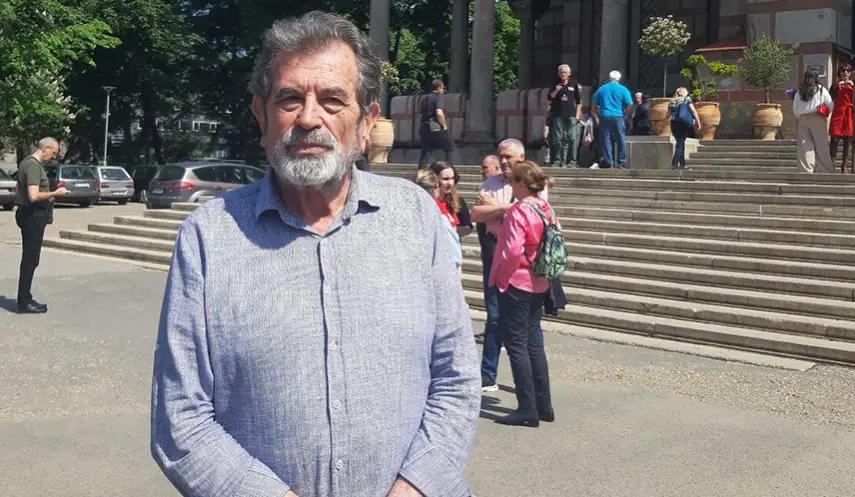
BELGRADE, MAY 7 /SRNA/ - The Director of the Documentation and Information Center Veritas Savo Štrbac told SRNA that recent desecrations and removals of memorials dedicated to victims of fascist terror in Croatia are further proof that, among young Croats, Ustashism is much closer to them than anti-fascism, which is one of the foundations of the Croatian Constitution.
He stated that the destruction of a memorial plaque in Sloboština near Požega during the May holidays, at the site where the Ustashe on 16 August 1942 killed more than 1,300 people, leaving behind the inscription "Crusaders and SS Men," is only a continuation of what began in the 1990s.
"The largest number of monuments were destroyed from 1991 to 1995. According to Croatian sources, during that period, outside the territory of the self-proclaimed Republic of the Serbian Krajina, held by Serbs, around 3,000 such monuments were destroyed, and about three million books with anti-fascist content and written in Cyrillic were destroyed," Štrbac said.
He pointed out that, regardless of what is written in their Constitution, after the war, Croats continued their struggle against communist and Partisan symbols, and over time equated the red five-pointed star with Pavelić’s Ustashe coat of arms.
"All of this has contributed to the rehabilitation of Ustashism. In October last year, under the roof of the Croatian Parliament, we had a `scientific` conference on Jasenovac, where we could hear claims that there was no killing based on national affiliation, that camp prisoners died of disease, that children were not brought there to be tortured and killed but to learn trades from top experts. It was also said that `The Little Floramye` was performed there, and that prisoners played football matches with guards, the Ustashe," Štrbac stated.
He also pointed out that the situation on the ground and the behavior of young Croats cannot be different when the singer Marko Perković Thompson, who in almost every song glorifies Ustashism and the Ustashe leader Ante Pavelić, gathers half a million fans at concerts.
"Their youth is the product of decades-long indoctrination and is a flawed product. It has been 31 years since the `Flash,` and soon it will be 31 years since the 'Storm’, and we can see how Croatian youth are being raised. You will rarely find an older person here destroying these monuments; it is precisely the youth who do it, younger people who were not in the war but were raised on Ustashe ideology. For them, it is something positive," Štrbac said.
He stated that Europe is founded on anti-fascism and that this is written into the constitutions of many countries, but that many behave quite differently in practice.
"Croatia is at the forefront of this. I am not excluding anyone, but Croatia has gone the furthest. I know how it is for my people who remained there," Štrbac said.
In the past few months, several World War II memorials and symbols in Croatia have been damaged or desecrated.
In Sloboština near Požega, during the May holidays, a memorial plaque was destroyed at the site where the Ustashe killed more than 1,300 people on 16 August 1942, and the perpetrators signed themselves as "Crusaders and SS Мen".
At the site where the original monument once stood, a plaque was installed by members of an anti-fascist association with the support of the Serb National Council.
In nearby Crljenci, a marble plaque bearing the names of victims was stolen.
In Budići near Pakrac, a plaque erected in honor of the 12th Slavonian Proletarian Assault Brigade was also stolen, and the red star was removed from the monument.
In the village of Gornji Grahovljani, a metal red star was removed from the top of a memorial monument, while in Dereza, a memorial plaque listing residents who went missing between 1991 and 1995, written in Cyrillic, was stolen.
The police, who conducted investigations in all cases, are still searching for unknown perpetrators.