EMPEROR DUŠAN CALLED `THE MIGHTY` FOR WHAT HE LEFT TO SERBS
Serbia - culture of remembrance
04/16/2026
14:16
BELGRADE, APRIL 16 /SRNA/ – Emperor Dušan was called the Mighty not because of the sword he carried or the size of the territory he ruled, but because of the vision he had and what he left to the Serb people, Serbia's Minister for Labour, Employment, Veterans and Social Affairs Milica Đurđević-Stamenkovski has said today in Belgrade at the marking the Day of Remembrance of Emperor Dušan's reign.
Đurđević-Stamenkovski emphasized at the marking the Day of Remembrance of Emperor Dušan’s reign, that this great ruler understood that the state and the Serbian Orthodox Church are "two eyes in one head" and that Serbs must protect one another.
Noting that six centuries have passed since Dušan's reign, she pointed out that there are still many who would like to reduce Serbia from a state that once reached three seas, to a state reaching three the Morava rivers, which will not happen.
Đurđević-Stamenkovski added that for centuries Serbs in Kosovo and Metohija have both gained and lost their state, noting that pine trees planted by Emperor Dušan and his son Uroš still grow there today as proof of their historical presence.
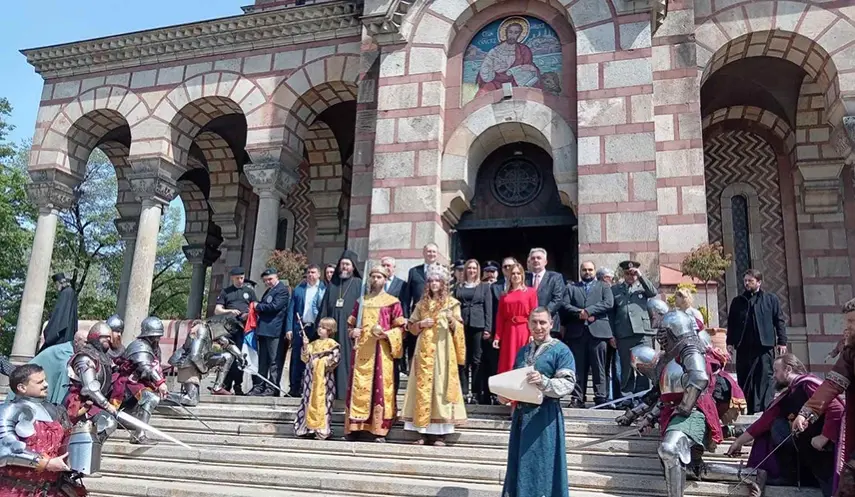
In the presence of a large number of citizens, representatives of the executive and legislative authorities, the Serbia's Army, and patriotic associations, a memorial service for Emperor Dušan was held at the Church of St. Mark in Belgrade, where his earthly remains rest.
The service was led by Bishop Dositej of Lipljan, who recalled in his sermon that Emperor Dušan, the most renowned statesman and leader of the Serb people, was crowned on Easter in 1346, which was no coincidence.
"With his coronation as emperor on Easter 680 years ago, he inscribed the Serb people into eternity," the bishop said.
Bishop Dositej emphasized that the legacy of Emperor Dušan serves as a lesson for present and future rulers that they are, above all, servants of Christ, wishing the Serbs to rise again with God’s glory after great suffering.
After the memorial service, wreaths were laid at Emperor Dušan's grave, while the state ceremony marking the Day of Remembrance of the reign of Stefan Uroš IV Dušan Nemanjić ended with a reenactment of his coronation, accompanied by period music, knights, and falconers.
Emperor Dušan, the most powerful ruler of medieval Serbia, was crowned in Skopje on Easter, April 16, 1346, as Emperor of the Serbs and Greeks.
At the same time or shortly before, the Serbian Patriarchate was proclaimed, elevating the archbishopric to the rank of a patriarchate, with Joanikije as the first Serbian patriarch.
This period marked the greatest rise of the medieval Serbian state, following the highly successful reign of King Milutin.
During the rule of Stefan Dušan - king from 1331 and emperor from 1346 - Serbia expanded far beyond the borders of the previous kingdom.
In addition to earlier territories, it encompassed Epirus, Thessaly, Acarnania, Aetolia, and all of Macedonia up to Christopolis - modern Kavala, except Thessaloniki, as well as nearly all of present-day Albania except Durrës.
This was not only a period of territorial expansion, but also of overall development, as evidenced by his achievements in construction and legislation.