BRICS - INSTITUTIONAL RESPONSE TO EXISTING MODELS OF GLOBAL GOVERNANCE
Serbia - forum
09/16/2026
09:00
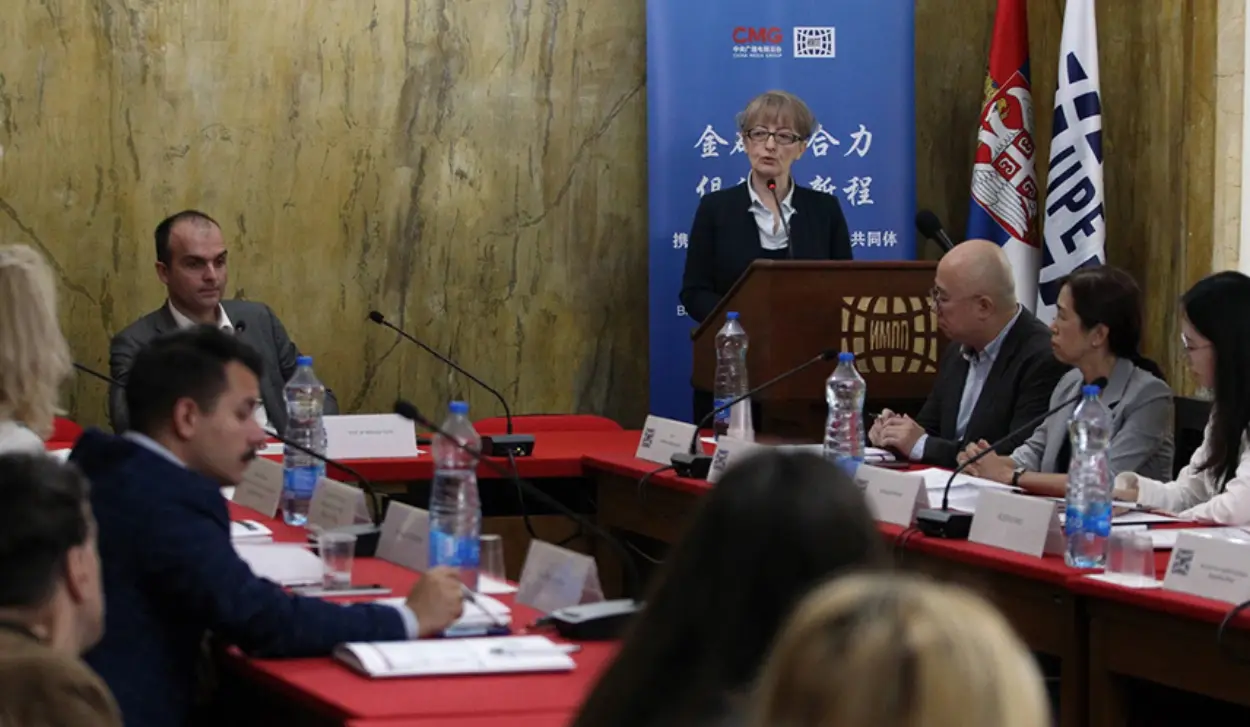
BELGRADE, SEPTEMBER 16 /SRNA/ - At the BRICS Forum in Belgrade, held following the BRICS leaders' summit in India, the growing importance of the Global South was highlighted, with BRICS described as an institutional response to existing models of global governance and as an opportunity for developing countries to play a greater role in international decision-making.
The forum, titled "BRICS 2026: Challenges of Global Political and Economic Transformation," discussed changes in the international order, the role of Global South countries, and prospects for cooperation between Serbia and China.
Gordana Mišev, director of the Institute of International Politics and Economics, said that BRICS may not be a single economic or even political alliance like the Non-Aligned Movement, but rather an institutional response to existing models of global governance.
She said some of BRICS' key objectives include reforming the economic and financial system, promoting more inclusive global governance, developing the digital economy and international trade, and changing the global political architecture.
Speaking about financial cooperation, Mišev stressed that the greater use of national currencies among BRICS members does not mean abandoning the dollar or having a confrontation with the United States, but rather aims to reduce transaction costs and facilitate trade among member countries.
She also highlighted the importance of developing digital infrastructure, artificial intelligence, start-ups and linkages between small and medium-sized enterprises, particularly when it comes to knowledge transfer and assistance to less-developed countries.
Mišev concluded that BRICS represents a new hope for small and developing countries, as it has the economic and political strength to help bring about a fairer global order.
Nataša Stanojević, a senior research fellow at the Institute of International Politics and Economics, said that the expansion of BRICS is changing the economic geography of the grouping and increasing its importance in international trade.
She said that the new members bring not only new markets, but also energy resources, production capacity, and access to important maritime and transport routes.
According to her, BRICS now connects a much broader area of the Global South and opens up opportunities for stronger trade ties between Asia, Africa, the Middle East and Latin America.
"BRICS brings together some of the largest markets, producers and exporters in the Global South and provides an institutional framework for addressing specific issues related to trade, investment, financing, transport and business cooperation. BRICS did not create the strengthening of the Global South, but its expansion gives this process a new institutional framework and additional impetus," Stanojević said.
She emphasized that the different economic structures of the member states create significant opportunities for economic cooperation, as some countries have energy and raw materials, some have large industrial capacities, and others have large markets.
According to the data she presented, intra-BRICS exports increased from USD 84 billion in 2003 to around USD 1.2 trillion in 2024, the China Media Group reported.
Stanojević also pointed to the rapid growth in trade among Global South countries, whose share of global merchandise trade rose from around 11% in 2000 to 28% in 2025.
She concluded that the next phase of BRICS' development will be measured not only by the number of its members, but by the grouping’s ability to turn its geographic reach and diverse economic potential into stronger trade, investment and production links among Global South countries.
Marina Raguš, Deputy Speaker of the National Assembly of the Republic of Serbia in a caretaker capacity, said that despite increasingly pronounced geopolitical divisions, Serbia continues to pursue a sovereign, independent and multi-vector foreign policy.
She stressed that Chinese President Xi Jinping's address at the BRICS summit in India points to the direction of future cooperation among Global South countries.
"He called on BRICS countries to take a leading role in four areas: promoting innovative development, preserving peace and stability, enhancing intercivilizational exchange, and reforming and improving global governance. These messages are also of great importance to Serbia," Raguš said.
She said that the traditionally strong relations between Serbia and China have been further enhanced and that, alongside infrastructure and traditional industries, the two countries are also developing cooperation in biotechnology, artificial intelligence, and chips, batteries and robotics manufacturing.
She also stressed that the two countries, which are bound by a steel friendship, share the view that it is important to respect sovereignty and territorial integrity, resolve disputes peacefully, and build a multipolar world.
According to her, the continued deepening of cooperation between Serbia and China is particularly important amid the challenging and turbulent international circumstances at present.
Luo Qi, a representative of the China Media Group, said that Chinese President Xi Jinping called on BRICS members at the summit in India to take a leading role in promoting innovative development, preserving peace and stability, enhancing intercivilizational exchange, and reforming global governance.
He added that China and Serbia support respect for sovereignty, dialogue and genuine multilateralism.
"Faced with divisions and confrontation, countries should choose openness, mutual respect and cooperation," Luo said.
Mitko Arnaudov, a research associate at the Institute of International Politics and Economics, spoke about BRICS' position in current international relations, caught between bloc divisions and genuine multilateralism.
He pointed out that cooperation is mentioned 157 times in the declaration adopted at the BRICS summit in India, while integration is mentioned only seven times, showing that the grouping’s goal is not to create a new political bloc.
"Multilateralism should be the goal we strive towards if we seek to strengthen international relations based on equal principles and standards of international law," Arnaudov said.
The forum was jointly organised by the China Media Group and the Institute of International Politics and Economics.
In addition to those mentioned above, the event was attended by Serbian State Secretary at the Ministry of Economy Andrea Horvat Kiralj, Counsellor at the Chinese Embassy in Serbia Liu Yinghui, and other guests.