31 YEARS SINCE BRUTAL MURDERS OF ELDERLY SERBS IN GOŠIĆ AND VARIVODE
Croatia - culture of remembrance - Veritas
08/26/2026
11:18
BELGRADE, AUGUST 26 /SRNA/ – It has been 31 years since the brutal and to this day unpunished murders of Serb civilians in the Bukovica villages of Gošić and Varivode, whose victims had an average age of 70, carried out in the weeks following the end of the Croatian military Storm operation.
Although the victims were exclusively elderly people who had remained in their homes, believing the official security guarantees given at the time, the Croatian judiciary has still, three decades later, failed to answer the question of who ordered and carried out these crimes, the Veritas Information - Documentation Centre said.
It stressed that to this day no one has been convicted either for these crimes or for many other crimes committed after Storm Operation in neighbouring Krajina villages. The ultimate consequence of these unpunished crimes has been the complete demographic disappearance of this part of Dalmatia.
The crime in the village of Gošić near Knin took place on August 27, 1995, when seven Serbs from the Borak family, aged between 56 and 81, were killed at close range on their doorsteps and in their yards.
Those killed were Savo Borak /70/, Vasilj Borak /68/, Grozdana Borak /75/, Marija Borak /81/, Kosovka Borak /77/, Milka Borak/75/, and Dušan Borak /56/.
A month later, on September 28, 1995, almost two months after the end of the hostilities, another ten Serb civilians, aged between 54 and 84, were killed in the nearby village of Varivode, including seven members of the Berić family.
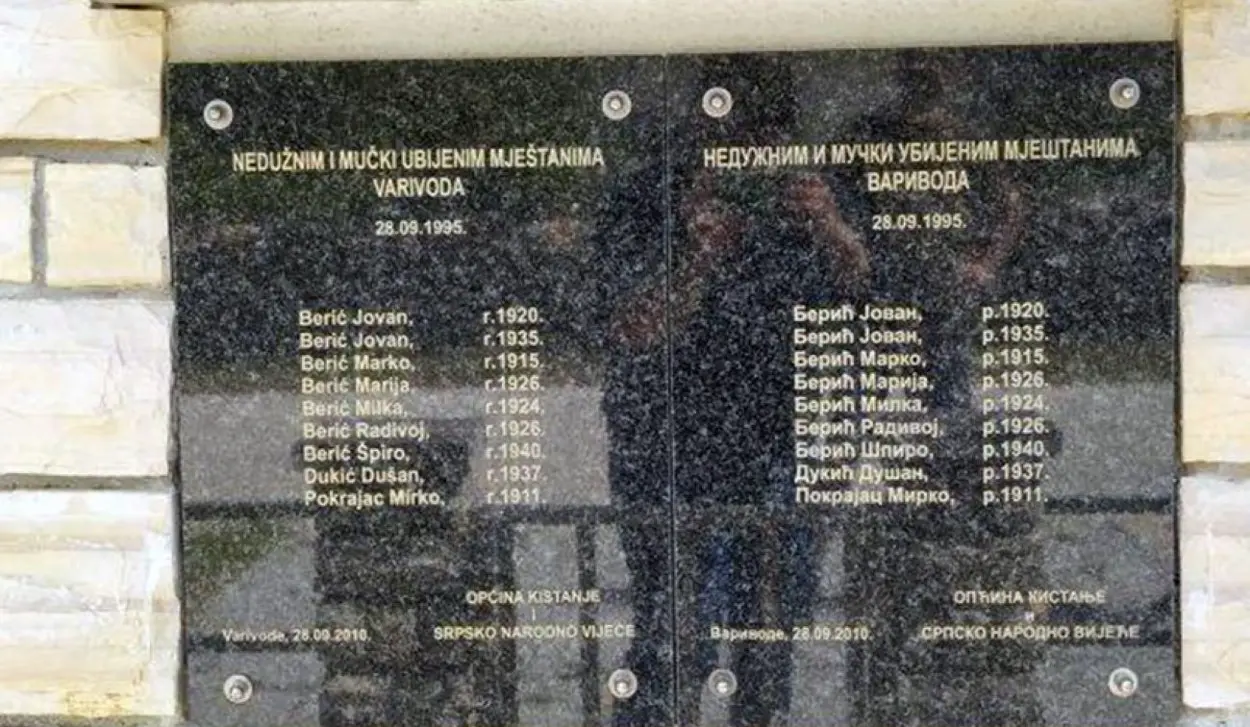
Those killed were Jovan Berić /75/, Špiro Berić /55/, Radivoj Berić /69/, Marija Berić /69/, Mirko Pokrajac /84/, Dušan Dukić /59/, Marko Berić /82/, Milka Berić /67/, Jovan Berić /56/ and Uglješa Ilijašević /54/, whose body was found in a local water and rainwater cistern.
In an attempt to conceal traces of the crimes, the Croatian police secretly buried the victims' bodies at the Knin cemetery under the designation "unknown".
It was not until the spring of 2001 that investigators from the Hague Tribunal exhumed their remains as part of a group of 301 bodies of people killed during and after Storm Operation, and their families identified them in 2002.
The memorials erected in their native villages by the Municipality of Kistanje and the Serb National Council have repeatedly been targeted by vandals and subjected to desecration.
Veritas stressed that the judicial outcome of these events had turned into a complete fiasco.
Under international pressure, the Zadar State Prosecutor's Office indicted six former Croatian soldiers as early as 1996 – Nikola Rašić, Ivan Jakovljević, Pero Perković, Ivica Petrić, Zlatko Ladović and Nediljko Mijić – for murders committed for personal gain.
Although four of the defendants confessed to the crimes during the investigation, the court in Zadar acquitted them that same year due to a "lack of evidence".
The Supreme Court of Croatia overturned the ruling, but at the retrial in Šibenik on February 13, 2002, the prosecutor completely withdrew the indictment, promising that a new investigation would be launched against other potential perpetrators.
According to the 1991 census, 107 people lived in Gošić, 106 of them Serbs, while Varivode had 477 residents, 472 of them Serbs.
"Three decades later, according to the 2021 census, only 21 people live in Gošić, with no one under the age of 40, while Varivode has 61 residents, none of whom is under the age of 25. This clearly illustrates the lasting consequences of the exodus and crimes of 1995," Veritas pointed out.

HIGH LEVEL OF CARE FOR ONCOLOGY PATIENTS AT SRPSKA UCC
KOVAČEVIĆ: CEC TO URGENTLY INVESTIGATE VULIĆ'S COMPLAINT OR ONCE AGAIN CONFIRM ITS ABSOLUTE INCOMPETENCE
JOVANOVIĆ: 3,000-YEAR-OLD KALAKAČA SITE SHOULD BE FURTHER EXPLORED

GREAT INTEREST IN ENROLLMENT IN BRANCH OF PRIMARY MUSIC SCHOOL