TRAILS OF EXODUS MARCH PARTICIPANTS SET OUT FROM TUMARE TOWARD STOG
FBiH - Exodus of Serbs - remembrance
09/10/2026
09:45
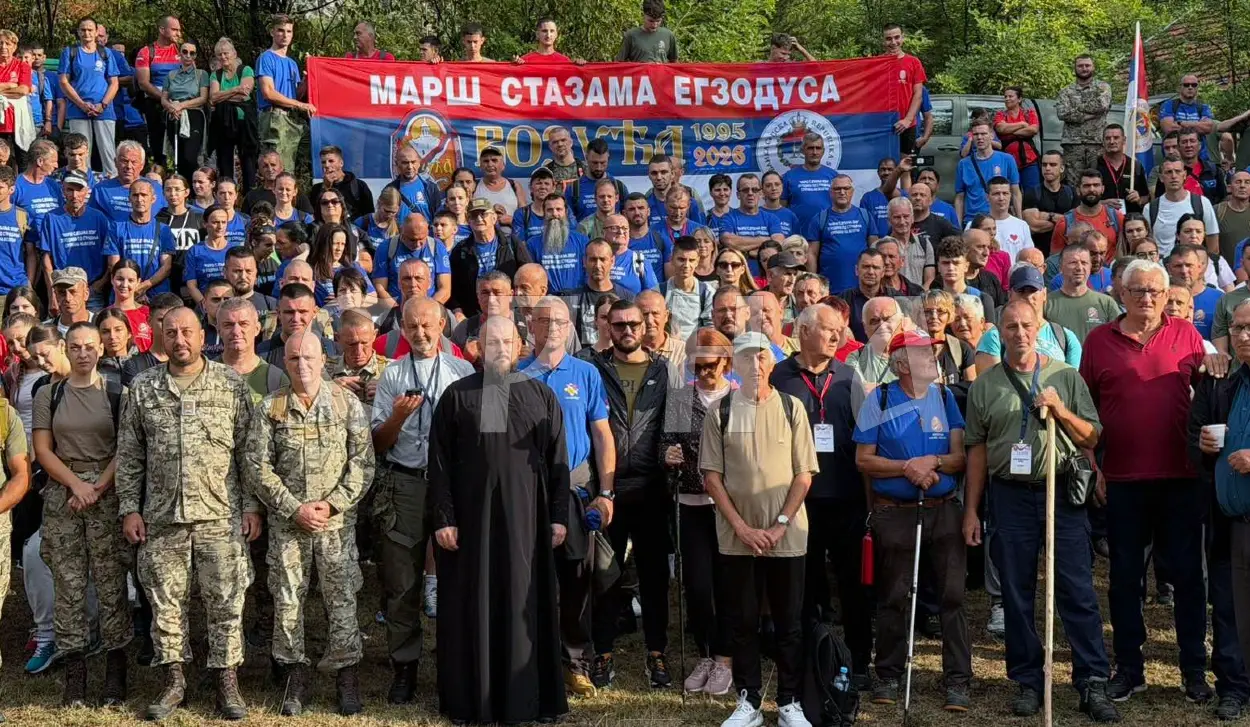
LUKAVAC, SEPTEMBER 10 /SRNA/ - Several hundred Trails of Exodus march participants, including Republika Srpska Minister of Labour, War Veterans and Disabled Persons Protection Radan Ostojić, set out from Tumare village on Mount Ozren toward Stog near Vozuća, Zavidovići Municipality, marking the 31st anniversary of the expulsion of Serbs from the Vozuća area, the Krivaja River valley, and southern and western Ozren.
Ostojić told SRNA that the march symbolically recalls the suffering of Serbs during the Defensive-Patriotic War.
"When we speak of sacrifice and suffering, one of the greatest burdens was borne by the Serb people of Ozren, who were expelled from their centuries-old homes," Ostojić said.
The march was organised by Doboj-based Association of Zavidovići People. Its head, Zoran Blagojević, said that they were not provoking anyone today, but were simply calling for the perpetrators and those who ordered the horrific crimes to be brought to justice and for information to be provided on the whereabouts of the remains of 129 Serbs from the area who were captured alive.
Also taking part in the march is Isidora Graorac, the head of the Republic Organisation of Families of Captured and Killed Soldiers and Missing Civilians, who said that the route taken by Serb soldiers and civilians seeking safety must not be forgotten, as many of them unfortunately did not survive.
She stressed that, 31 years later and despite numerous appeals, the remains of 129 Serb soldiers and civilians are still missing.
"It is important to take part in the march so that we know where we were and where we come from, and that we can pass on to those who come after us what we as a people went through, especially the people from this area and the entire Ozren mountain," Graorac said.
Among the participants is also Petrovo Mayor Ozren Petković, who stressed the importance of preserving the culture of remembrance of the 1990s events.
"May it never happen again. We must protect Republika Srpska, but we must also not forget where our centuries-old homes are," Petković said.
Members of the Third Infantry Regiment /Republika Srpska/ of the BiH Armed Forces are also participating in the march.
Before the march, participants attended a service at the Church of the Holy Trinity in Tumare and received a blessing.
The participants will follow a 22-kilometre route. It is a truck road running from Brijesnica Gornja through Kvrga, Malčići, Borovci and Lozna to Stog, along which Serbs from Vozuća and the Krivaja valley withdrew in the face of forces of the so-called Army of BiH.
After the march, participants will gather at the Church of St. George in Stog, where a memorial to fallen and missing soldiers is located. A divine liturgy will be served there, followed by the laying of wreaths at a memorial chapel currently under construction, in remembrance of 21 Serb soldiers and civilians who were brutally killed and whose remains, most of them decapitated, were discovered after the war ended.
Serbs from Vozuća were expelled from their centuries-old homes during an offensive by the so-called Army of BiH, which, depending on the unit and direction of the enemy forces’ attack, was known as “Hurricane 95,” “Farz 95,” and “Badr al-Bosna.”
The mass suffering of the people of Vozuća lasted from September 10 to 24, 1995, as a result of an offensive involving 23,000 Muslim soldiers from the Second and Third Corps of the so-called Army of BiH and the El Mujahideen Detachment, as well as NATO bombing supported by their rapid-reaction units and a Pakistani contingent of international peacekeeping forces.
During that period, 30 Serb villages were burned, 1,920 Serb families comprising 7,680 people were expelled, and 459 Republika Srpska Army soldiers and civilians were killed, while the whereabouts of many others remain unknown.
The fall of Vozuća brought to an end the expulsion and ethnic cleansing of Serbs from the Zenica region, which had begun in 1992.
For the horrific crimes against Serbs in Vozuća and Zavidovići, only two individuals have so far been convicted: former Chief of the General Staff of the so-called Army of BiH Rasim Delić, who was sentenced to three years in prison by the Hague Tribunal, and commander of the Third Corps of the so-called Army of BiH Sakib Mahmuljin, who is not serving his eight-year sentence because he fled BiH.
Mahmuljin is one of 19 members of the so-called Army of BiH and foreign volunteers against whom criminal complaints have been filed over crimes committed against Serbs in the Ozren and Vozuća areas in July and September 1995.