SERBS THROWN INTO PITS BY THEIR CROAT NEIGHBOURS; CATHOLIC PRIESTS KNEW BUT DID NOT STOP IT
FBiH – Prebilovci – culture of remembrance
08/07/2026
14:44

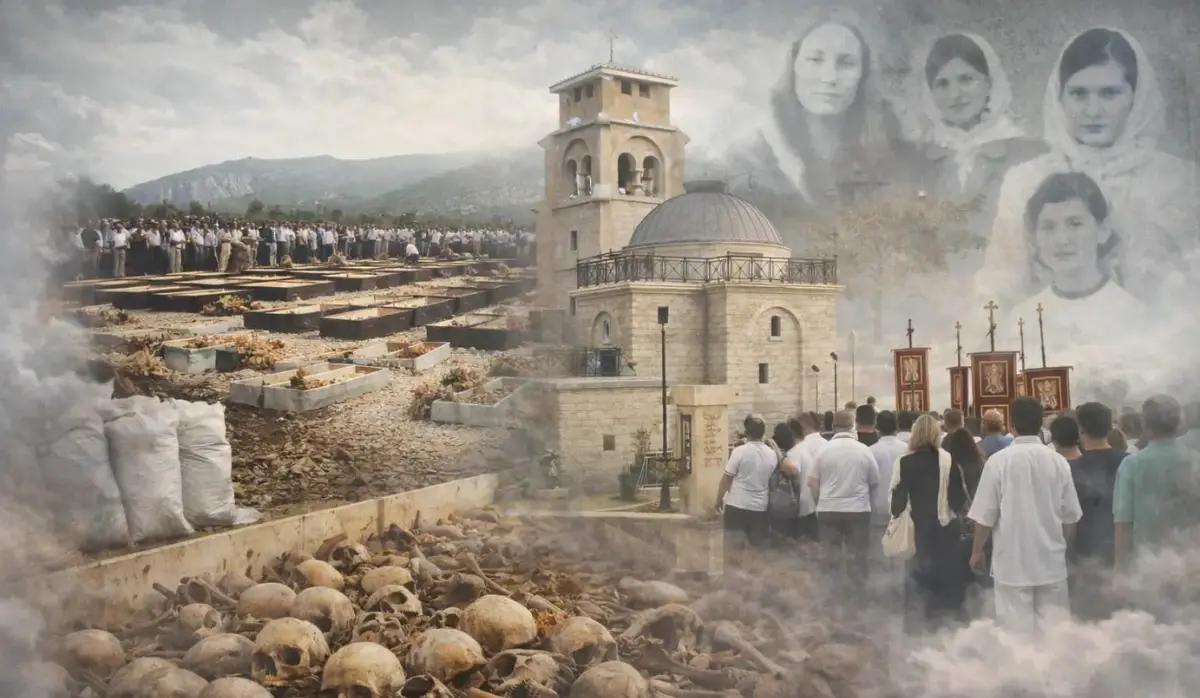
BELGRADE, AUGUST 7 /SRNA/ - Milenko Jahura, founder of the Serbian National Society Prebilovci in Belgrade, told SRNA that history should remember that the Serbs of Prebilovci were killed by Croats from neighbouring villages between August 4 and 28, 1941, and that Catholic priests must have known about it but did not prevent it.
Jahura said that the final massacre of Serbian children, women, and the elderly in the village took place on August 28, 1941, on the banks of the Bregava River, on the major Orthodox feast of the Dormition of the Most Holy Theotokos.
He pointed out that the people of Prebilovci were killed between August 4 and 28 in their homes, in the fields, in the forests, and in and along the Bregava River, noting that the largest number of them were executed on August 6.
EXECUTIONERS USED POLES TO PUSH SERBS INTO PITS, MERCILESSLY KILLING CHILDREN
"They were arrested on August 4 and transported in cattle cars to the railway station in Šurmanci. They spent the night in the railcars without food or water in the scorching heat, and the next day they were forced out, where the abuse continued. They were then marched in a column to the Golubinka Pit. It is located on Crnica Hill, with Šurmanci on one side and Međugorje on the other. The entire area belongs to the Catholic parish of Međugorje," Jahura said.
He said that the Serbs were brought in groups to within about 100 metres of the pit, after which five or six of them at a time were separated from the others and taken to the edge of the pit.
"Around the pit were... We may call them Ustashas, but in reality they were Croats – local residents, villagers who wore no uniforms and held no military positions," Jahura told SRNA.
He said that the executioners pushed their victims into the pit with wooden poles – long, heavy poles known in that region as pouzice.
"Serbian children clung to their legs, trying to escape, but they chased them across the hill and struck their fingers until they fell. No one survived, nor did anyone manage to escape," Jahura said.
He stressed that the brutality of the killings was most vividly testified to by members of the Muslim Tikveša family, whose house was the closest to the pit and who did not take part in the crimes.
CATHOLIC PRIESTS MUST HAVE KNOWN ABOUT THE MASSACRE
Jahura believes that Catholic priests knew what was happening at this and all other killing sites, and stressed that it should not be forgotten that the Catholic Church created the NDH, which they described as "God's state."
"In our area, there is no testimony that any friar took part in the killings, but here it was done 'with gloves on'. He sits somewhere over there in the parish house, supposedly praying to God and reading something, while his followers kill children and throw them into pits; afterwards he hears their confessions, gives them Communion, and watches as Serbian homes in Prebilovci and Klepci are emptied, looted and burned," Jahura said.
According to him, if that friar had been a true man and had stood before his "faithful" and told them that they could only kill through his dead body, perhaps everything could have been different, and the massacre could have been stopped.
"In Prebilovci, we did not have Catholics living in the village, but in these other villages, Serbs trusted them and did not flee anywhere. The main responsibility lies with the Roman Catholic clergy in Čapljina, Gabela, Klepci, Dračevo and everywhere where there were mixed communities. There is not a single piece of evidence that they saved anyone, but there is evidence that they informed on Serbs," Jahura said.
THE CRIME AGAINST SERBS REPEATED IN 1992
He stressed that the crime repeated in 1992 followed a similar scenario, and that the regular Croatian army left its mark on the area of Prebilovci and Lower Herzegovina.
"After the withdrawal of the Yugoslav People's Army /JNA/ from that area, the Serbs were organised only at the level of village guards. They were unable to resist the attack during Operation Lipanjska zora, which involved the Rijeka Brigade. That brigade was there, and they openly boast about it. Croatia stands behind it and bears responsibility. They could not have done anything without it," Jahura said.
SETTLING CROATS FROM CENTRAL BOSNIA TO CONSOLIDATE THE EFFECTS OF ETHNIC CLEANSING
He believes that settling Croats from central Bosnia in areas where Serbs had lived until 1992 was also a state project aimed at entrenching genocide and ethnic cleansing.
"They built a large number of houses for them in every place where they had lived alongside Serbs, in Klepci, Tasovčići and Dubrave, on state-owned land, while Serbian private property was also usurped," Jahura said.
He stressed that houses were built for the newcomers on top of Serbian pits, something he said he had personally witnessed.
"I was with a friend in a place near Čapljina looking for the site where six Serbian boys were killed. My friend said he knew it was somewhere around there, but he was unable to identify it; everything there consisted of new houses and lawns," Jahura said.
He said that they introduced themselves to a woman as speleologists from Sarajevo and asked her whether she knew if there was a pit somewhere nearby, and she showed them the place where a house with a yard had been built.
"The owner lives on top of the pit," Jahura added.
He pointed out that they failed to settle Croats in Prebilovci as well, because they probably did not expect any Serbs to ever return after a complete genocide had been committed against them in the 20th century.
Jahura said it was encouraging that people were speaking about Prebilovci, one of the four villages that suffered the greatest losses in the world during the Second World War, and that school excursions, primarily from Republika Srpska, as well as pilgrims visiting Herzegovina’s monasteries and Ostrog, regularly stop there.
"Many school groups come from Republika Srpska and Montenegro, and occasionally from Serbia as well. In each of those groups, there is someone who will listen, remember and pass the truth on to others. That is what we wanted," Jahura stressed.
The crime committed in Prebilovci gave this Herzegovinian village a fate comparable in Europe, during the Second World War, only to that of the village of Lidice in the Czech Republic.
In the verdict against Ustasha criminal and commander of the attack on Prebilovci, Ivan Jovanović Crni, the District Court in Mostar established that 33 Prebilovci households were completely extinguished and that a total of 830 people perished - murdered, killed in the fighting, or thrown into the Šurmanci Pit.
On the Feast of Saint Mary the Merciful on August 4, 1991, the remains of around 4,000 Serbs from Prebilovci and other killing sites in Lower Herzegovina were placed in the crypt of the Memorial Church in Prebilovci /which was still under construction at the time/. The memorial service, which had been awaited for half a century, was conducted by the late Serbian Patriarch Pavle.
During the war, in June 1992, all the houses in Prebilovci were burned and destroyed, and Croats mined and razed the memorial ossuary to the ground, turning the entire area into an illegal dump.
The Memorial Church of Christ’s Resurrection in Prebilovci was built and consecrated in 2015, and that same year the Prebilovci martyrs were entered into the Book of Saints.
The name of Ivan Jovanović Crni appears among the names of around 1,600 Ustashas who died "for Croatian freedom" on a monument erected in Čapljina in 2002.