VULIĆ SENT PARLIAMENTARY QUESTIONS, AFTER ANSWERS SIGNED BY COURT'S SECRETARY
BiH - incomplete Constitutional Court
06/03/2026
11:49
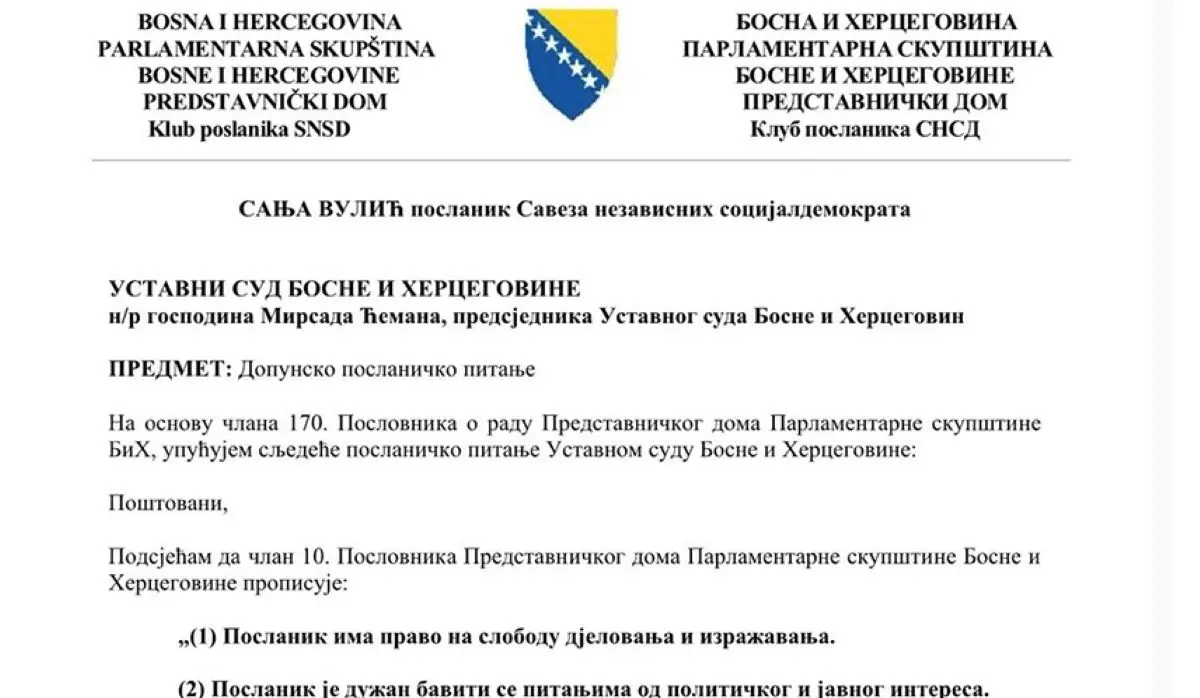
SARAJEVO, JUNE 3 /SRNA/ - The Head of the SNSD Caucus in the House of Representatives of the BiH Parliamentary Assembly Sanja Vulić sent supplementary parliamentary questions to the incomplete Constitutional Court of BiH, after receiving answers to questions she did not even ask, which were signed by the secretary of the judicial institution.
Vulić told SRNA that she did not get a specific answer from the incomplete Constitutional Court of BiH to the questions she asked - instead, a statement that mostly deals with the issue of parliamentary oversight was delivered, although such an issue was not the subject of her address at all, which she assessed as scandalous.
"I addressed my parliamentary question to the President of the /incomplete/ Constitutional Court of BiH Mirsad Ćeman, and not to the Secretariat of the Constitutional Court of BiH," said Vulić.
In a supplementary parliamentary question, she asked on the basis of which legal act, regulation or authority does the secretary of the incomplete Constitutional Court of BiH answer parliamentary questions addressed to the president of that judicial institution?
"Was the president of the /incomplete/ Constitutional Court of BiH familiar with the content of my parliamentary question and did he approve the content of the submitted answer? Do you think that the /incomplete/ Constitutional Court of BiH in its current composition and with such an answer to the democratically elected deputy in transparent and verified elections supports the Constitution, which is its role prescribed by the Constitution?" asked Vulić.
Vulić especially emphasized that with this parliamentary question she did not exercise, nor did she try to exercise, parliamentary supervision over the incomplete Constitutional Court of BiH.
"Taking into account the content of the submitted response, it remains unclear why the response to specific questions of public and political interest related to the implementation of the Constitution of BiH is being avoided," Vulić said.
She assessed that such an approach opens up a serious question of relationship to the rights and duties of deputies, established by the Rules of Procedure of the House of Representatives of the Parliamentary Assembly of BiH, as well as to the obligations arising from the constitutional order of BiH.
"Therefore, I expect the President of the /incomplete/ Constitutional Court of BiH to submit an answer to the questions raised and to declare on their essence," said Vulić.
Vulić reminded that Article 10 of the Rules of Procedure of the House of Representatives of the BiH Parliamentary Assembly prescribes that the deputy has the right to freedom of action and expression and that he is obliged to deal with issues of political and public interest.
"So, as a member of the House of Representatives, I have not only the right, but also the obligation to deal with issues of political and public interest, including issues related to the constitutional order of BiH and the implementation of the Constitution of BiH", emphasized Vulić.
She previously sent a parliamentary question to the Constitutional Court of BiH regarding the acceptance and implementation of acts that were not adopted by the Parliamentary Assembly of BiH, as was the case with the changes to the Criminal Code of BiH imposed by Christian Schmidt.
In the parliamentary question, Vulić also submitted an act of the Secretariat of the Parliamentary Assembly of BiH, from which it follows that the changes to the Criminal Code of BiH, on the basis of which the proceedings against the then President of Republika Srpska Milorad Dodik were conducted, were neither discussed nor adopted, neither in the House of Representatives nor in the House of Peoples.
"How does the /incomplete/ Court justify the application of such acts in relation to the principle of legality and the constitutionally guaranteed rights of citizens to vote and be elected? How do you explain the procedure for decisions that declare the law of a person who presents himself as a `high representative` and is this in accordance with Articles I/2 and IV/3 c) and h) of the Constitution?" asked Vulić.