PROFESSIONAL DRIVERS CANNOT BE TREATED AS MIGRANTS
BiH – transport operators
08/31/2026
13:36
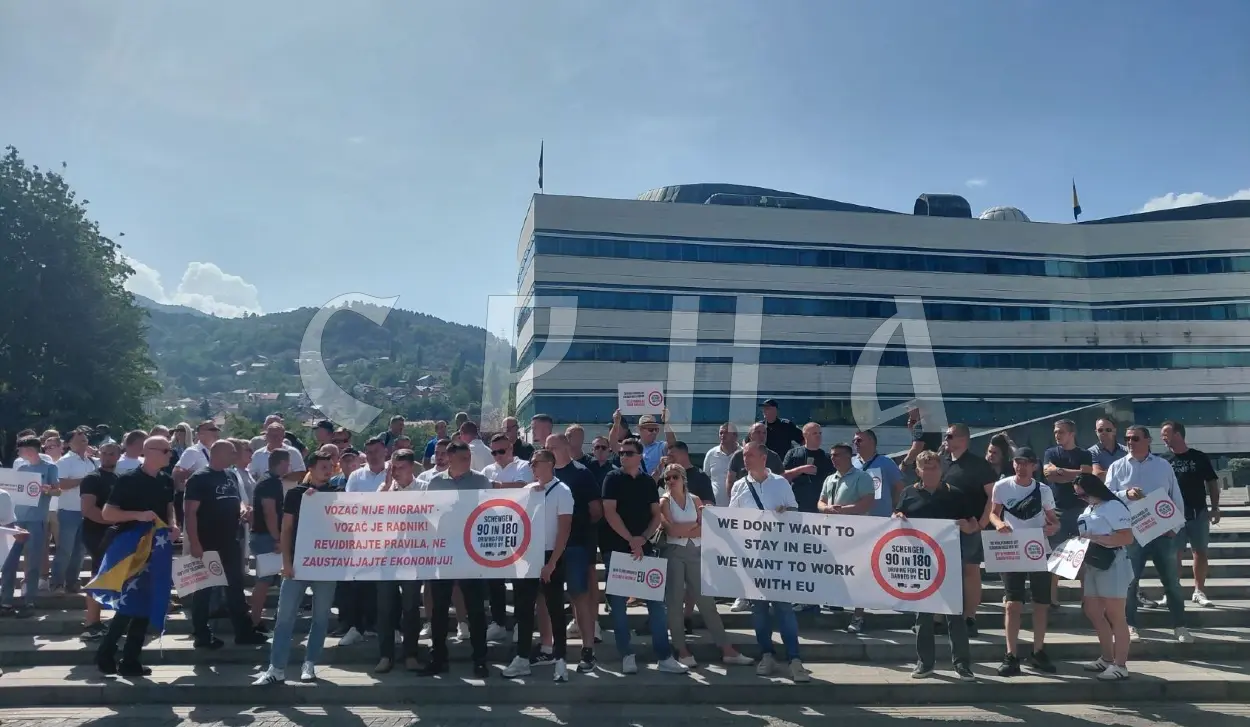
SARAJEVO, AUGUST 31 /SRNA/ - Transport operators from BiH gathered today in front of the Parliamentary Assembly of BiH in Sarajevo, where they said they would not give up their demand to resolve the problem faced by professional drivers whose stay in the Schengen Area is limited by the 90/180-day rule.
Zijad Šarić, Chairman of the Board of the Logistika BiH Consortium, said that professional drivers cannot be treated as migrants because they are duly registered as employees of companies in BiH, Serbia, Montenegro and North Macedonia and simply want to do their jobs.
Šarić said that Croatia has taken certain steps aimed at resolving the problem, but that a regulation specifying how visas will be issued to professional drivers from these countries has not yet been adopted.
He said that Europe should finally wake up and realize that transport operators will not give up their demands, and that he expects the European Commission to hold a meeting tomorrow at which the issue of professional drivers’ stay will be among the topics discussed.
Šarić said that transport operators are not seeking a special law just for them, but are proposing, among other things, an increase in the permitted number of days they can stay in the EU.
"If nothing else, we are asking for the permitted stay to be extended from 90 to 125 or 130 days. We simply want to work and transit through EU countries," Šarić said.
He said that transport operators have held talks with representatives of the European Commission and domestic authorities in recent months, working groups have been formed, and meetings have also been held between representatives of BiH, Serbia, Montenegro and North Macedonia.
Nikola Brković, a member of the Logistika BiH Coordination from Prnjavor, said that after exceeding the permitted 90-day stay in some countries, professional drivers are treated in the same way as people who are staying illegally in the EU.
He said that drivers are taken in for questioning and asked where and how they entered the country and what they intend to do, even though they are permanently employed and are at their place of work.
According to him, the consequences vary from country to country. In Austria, Germany and the Czech Republic, drivers may be deported, while in Croatia they are generally turned back at the border.
Brković said that financial penalties are not the biggest problem, but rather bans on entering the EU, which can last from three to 12 months.
According to his estimate, around 5,000 drivers in BiH are engaged exclusively in international transport.
If tomorrow's European Commission meeting does not produce a positive response or a concrete solution, Šarić announced that regional protests would be held on September 14, with the possibility of blocking border crossings into the EU.
"Most likely, the borders will be blocked, along with all goods bound for the EU," Šarić said, clarifying that the blockade would apply only to borders with the EU.
The transport operators' protest is also being held simultaneously in Serbia, Montenegro and North Macedonia. Following the gathering in front of the Parliamentary Assembly of BiH, the protest convoy headed towards the EU Delegation in Sarajevo.
Transport operators point out that the 90/180-day rule, under which third-country nationals without an appropriate long-term permit may stay for no more than 90 days in any 180 days, makes it more difficult for professional drivers from Western Balkan countries to carry out international transport.

FINANCIAL ASSISTANCE FOR PRIMARY, SECONDARY SCHOOL AND UNIVERSITY STUDENTS
JOINT EFFORTS SAVE LIFE OF AN EIGHT-YEAR-OLD BOY
STEVANDIĆ TO FIELDS: SRPSKA INTERESTED IN COOPERATION WITH U.S.
KOJIĆ: SOMEONE IS DELIBERATELY STOKING TENSIONS IN SREBRENICA