JEFTANOVIĆ LEGACY REMAINS IMPORTANT PART OF SARAJEVO'S COLLECTIVE MEMORY
BiH - Andrea Jeftanović
09/26/2026
09:31
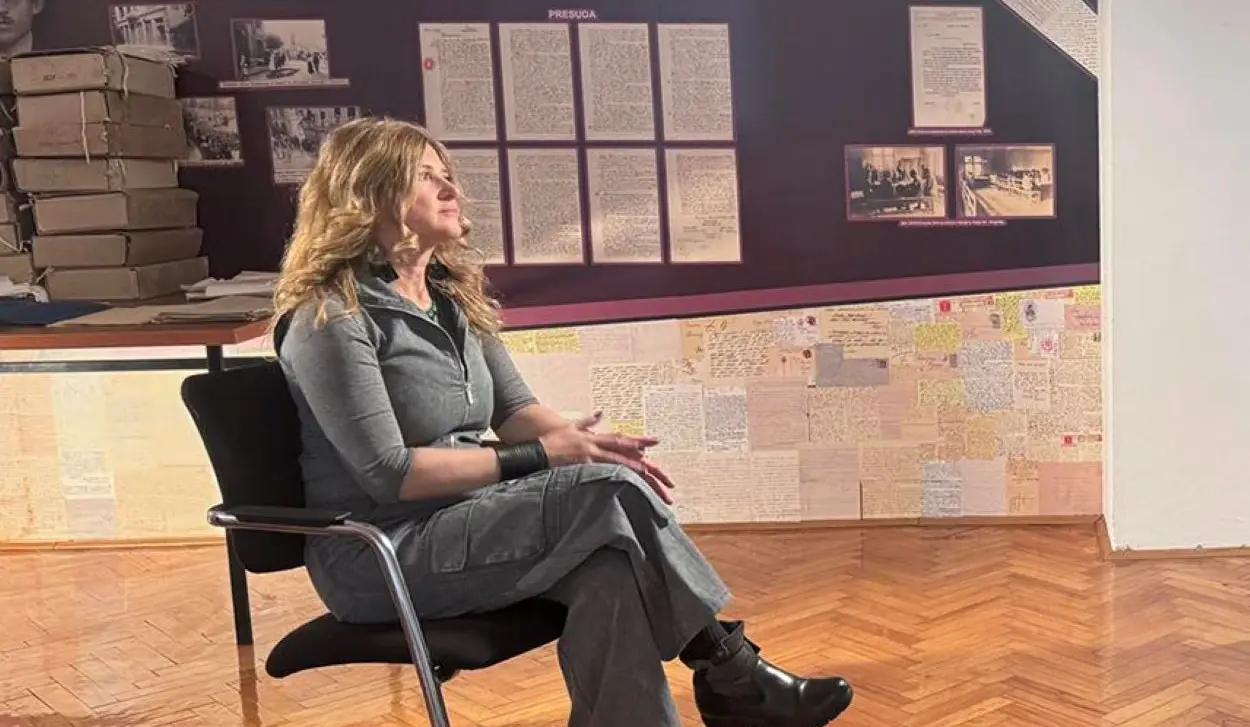
SARAJEVO, SEPTEMBER 26 /SRNA/ - Andrea Jeftanović, great-granddaughter of one of Sarajevo's most prominent Serbs, Gligorije Jeftanović, says the story of her family is an important part of Sarajevo's history that should be preserved.
By Željka DOMAZET
In an interview with SRNA, Andrea Jeftanović says the story of the Jeftanović family is not merely her own family story, something she only began to fully understand in 2021.
Asked who Gligorije Jeftanović was to her before she began working on a film about the family, Andrea says that before the project, her great-grandfather was primarily a name on the family tree - an important ancestor surrounded by photographs, legends, but also silence.
GLIGORIJE JEFTANOVIĆ - BENEFACTOR WHO HELPED SHAPE MODERN SARAJEVO
"I knew he was a visionary and was familiar with some of his projects, but as a person he remained quite distant to me. I now understand him as a complex historical figure - a businessman, political representative, benefactor and one of the people who helped shape modern Sarajevo. He built Hotel Evropa and supported schools, religious institutions, choirs and civic organizations," Jeftanović says.
She stressed she was proud of her renowned ancestor not because of his economic influence, but because of his dedication to Sarajevo and its people.
"I value his ability to engage in dialogue and his willingness to cooperate with people of different faiths and backgrounds. Still, I do not want to turn him into a monument. My research also uncovered family conflicts, privilege, losses and unresolved questions. He became more human to me - not just a famous ancestor, but someone whose decisions still cast both light and shadow over several generations," Andrea says.
Asked what she discovered about her family during filming and research, and what surprised or moved her most, she says she was deeply touched to discover that people outside her family had preserved parts of the Jeftanović family memory.
"One person had kept letters, another photographs, and a third a portrait slashed with an Ustasha bayonet, which was later carefully restored. In the Archives of BiH, I found 12 boxes tracing the family's history through war, property confiscation and nationalization. I also learned about conflicts between siblings and about silences passed down from generation to generation," Andrea Jeftanović says.
She notes that perhaps the greatest surprise was realizing that her family history had not disappeared.
"It had been scattered, and many different people had, without even realizing it, become its custodians," Jeftanović says.
Andrea says she began to understand the full significance of the Jeftanović family for Sarajevo in 2021, when Moris Albahari appeared on a television program in BiH looking for a descendant of the Jeftanović family.
"Journalist Aleksandra Tolj told me about the story with great sensitivity," Jeftanović says, adding that Tolj "has since become something of a good fairy to this project."
Andrea says messages soon began arriving from Sarajevo, Belgrade, Athens, Boston and Jerusalem.
"People I had never met knew things about my ancestors that no one had ever told me. They spoke about Hotel Evropa, the family businesses, schools, cultural institutions and humanitarian work. Many believed there were no living descendants left," Gligorije’s great-granddaughter says.
Andrea says that was when she realized her family's silence had also created "a gap in Sarajevo's public memory."
"Preserving this story became a way to reconnect those two forms of memory," Andrea says.
FROM SARAJEVO TO CHILE
Her family moved thousands of kilometers away, to Chile, and asked how the family managed to preserve memories of Sarajevo and their ancestors from such a distance, Andrea says her father left Sarajevo in 1942, when he was nine years old, after her grandfather was arrested and taken to Jasenovac.
"With his mother and siblings, he made his way across Europe, and they later sailed by ship to South America. In Chile, Sarajevo survived in fragments - through old photographs, letters written in languages I did not understand, half-remembered names, family anecdotes and a certain silence. We did not inherit a complete history; we inherited scattered pieces and a sense that something important had been lost," Andrea says.
She stressed that writing the book meant returning to those fragments and asking questions about what previous generations could not, or did not want to, tell.