FILM "THE OLD WATCH" SEEKS TO REVIVE MEMORY OF OLD SARAJEVO
BiH - Andrea Jeftanović
09/27/2026
09:10
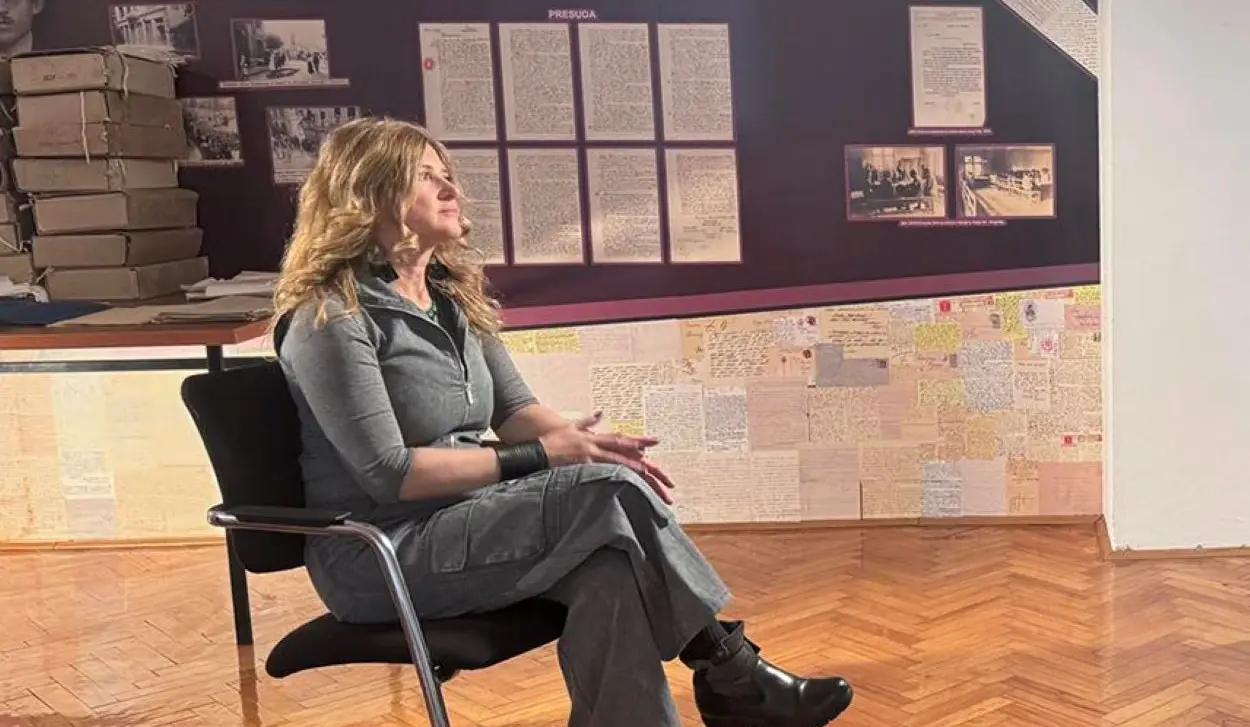
SARAJEVO, SEPTEMBER 27 /SRNA/ - Andrea Jeftanović, great-granddaughter of one of Sarajevo's most prominent Serbs, Gligorije Jeftanović, says the film being made about her family is titled The Old Watch and that she hopes it will preserve more than the history of one distinguished family - the ability to recognize the human being in another person, even when they stand on the opposite side.
By Željka DOMAZET
"I want to revive the memory of a Sarajevo in which neighbors of different faiths and traditions shared streets, languages and everyday life, even when political forces tried to turn them into enemies. The watch preserves the memory of a moment when one man first saw a human being in his wounded neighbor," Andrea Jeftanović said.
Speaking to SRNA, Andrea said she wanted the film to show how objects, archives and encounters with strangers can reconnect histories torn apart by war and migration.
"If the watch keeps ticking, it reminds us that memory requires care and that human solidarity can sometimes outlive catastrophe," Andrea said.
OLD DOXA POCKET WATCH
She said the entire story begins during World War I, when David Albahari, a soldier in the Austro-Hungarian army, recognized a wounded member of the Jeftanović family from Sarajevo on the battlefield, carried him on his back to a field hospital and saved his life.
"After the war, the Jeftanović family offered him a new gold watch, but David refused it. Instead, he asked for the old Doxa pocket watch that the wounded soldier had worn during the war," Andrea said.
She said the Albahari family preserved the watch through three wars, and more than a century later, David's son Moris returned it to her.
"Moris was not simply the custodian of that object. At the age of 12, he joined the Partisans and survived World War II thanks to extraordinary courage and resourcefulness. Through him, I also discovered the rich history of Sarajevo's Sephardic Jewish community and its remarkable contribution to the city. This has deep personal meaning for me because I am the child of an interfaith marriage, with a Serbian Orthodox father and a Sephardic Jewish mother. The watch connects those two heritages," Jeftanović said.
Andrea said the watch does not represent wealth, but courage, gratitude and the ability to recognize the human being in another person, even when that person is on the opposite side.
I FEEL CLOSE TO MY ANCESTORS, BUT I AM STILL A VISITOR FROM CHILE
Walking through Sarajevo today and passing places her ancestors built or helped shape, Andrea Jeftanović says the feeling is both intimate and unsettling.
"I walk past Hotel Evropa, enter the former family apartment, climb its marble staircase and visit the mausoleum, yet none of those places truly belongs to me. I am returning to a city where I never lived, guided by the memories of people who are no longer alive. I feel close to my ancestors, but at the same time I am still a visitor from Chile. That distance is painful, although it was precisely from that distance that this book began," Andrea Jeftanović says.
She noted that people in Sarajevo had welcomed her with such respect and care that with each visit she increasingly feels that she belongs to the city.
"I have made close friends who already feel like family. I am learning the language and, in the near future, I hope to spend several months in BiH and bring my entire family with me. I would also like to reclaim at least one family property - not merely as an asset, but as a place where, even briefly, I could feel what it means to have a home," Andrea Jeftanović stressed.