DODIK: BiH MUST BE BASED ON LETTER OF DAYTON ACCORDS IF IT WANTS TO FUNCTION
BiH - Dayton Peace Agreement - anniversary
11/20/2026
14:27

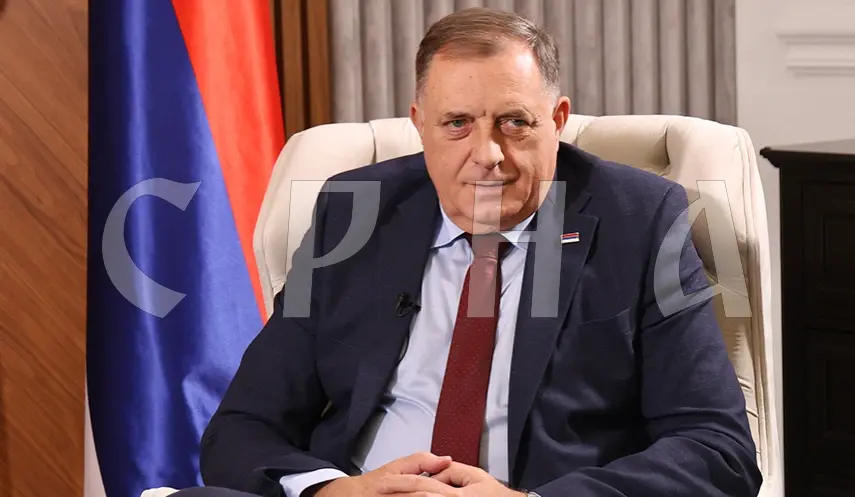
BANJA LUKA, NOVEMBER 20/SRNA/ – If BiH wishes to function as a state community consisting of two entities and three constituent peoples with equal rights, it must, above all, be based on the letter of the Dayton Peace Agreement, rather than on what self-declared “architects”, both local and international, wanted to turn it into, President Milorad Dodik stated.
Marking the 31st anniversary of the initialling of the Dayton Peace Agreement on 21 November 1995 at Wright-Patterson Air Force Base in Dayton, the United States, Dodik told the Republika Srpska Media System – SRNA that the same debate over what the document actually represented, and what successive interpretations over the years have attempted to turn it into, is raised not only on the anniversary but almost every day.
"For many, and especially for us in Republika Srpska, respecting the letter, rather than the `spirit` of the Dayton is not merely a legal or political issue. It is a question of our survival and identity, our institutions, competences and Republika Srpska itself, as well as the structure of what constitutes BiH, namely two equal entities – Republika Srpska and the FiH – and three constituent peoples – Serbs, Croats and Bosniaks," Dodik stressed.
He recalled that Republika Srpska entered the Dayton negotiations as an entity with full capacity, bringing its territory, population, government and sovereignty – the four basic elements of statehood. This demonstrates, Dodik says, that the Dayton Agreement, or Annex Four, which constitutes the Constitution of BiH, did not create the entities but confirmed them and granted them international recognition.
He said that the key concept of the Peace Agreement was the decentralisation of BiH, which remains the only guarantee of security and a mechanism ensuring that no people is outvoted or placed in a position of dominance over another.
"Today, 31 years later, instead of engaging in internal dialogue without foreign interference and discussing political understanding, better cohesion within BiH, economic development and prosperity, and a better life for all peoples in BiH, Republika Srpska still has to fight to preserve its constitutional competences, restore those that have been taken away and prevent further erosion of its authority," President Dodik pointed out.
FROM LETTER OF DAYTON TO CONSTANT ATTEMPTS AT CENTRALISATION
The seizure and transfer of competences from the entity level to the level of BiH has become a practice of official Sarajevo and Bosniak political representatives, Dodik said, leading towards an outright transformation of the constitutional structure of BiH, completely contrary to what was agreed in Dayton.
"Our arguments against such actions are entirely precise and clear. The Constitution of BiH explicitly defines the competences of the state-level institutions, while all other powers automatically belong to the entities. Through the actions of high representatives and the use of the so-called `Bonn Powers,` the will of the peoples' elected representatives has often been bypassed, structures have been altered and powers transferred, including those relating to the judiciary, the military and indirect taxation, without the consent of the entity parliaments.
Such moves did not strengthen the functionality of BiH, as their proponents tried unconvincingly to justify, but instead resulted in serious violations of the Dayton and the Constitution of BiH, producing one prolonged political crisis after another and creating a constant atmosphere of hostility," Dodik stressed.
He pointed out that the seizure of competences is not merely a technical transfer of responsibilities, but a direct attack on the constitutional structure of BiH, the Constitution itself and, consequently, Republika Srpska.
"If the Constitution states that BiH consists of two entity-states that make up BiH, then every move that transforms that structure into a unitary BiH undermines the Dayton and violates that same Constitution, the highest general legal act in a country's legal system," Dodik said.
He stated that returning to the letter of the Dayton means defending legality and respecting the right of the entities to independently decide on matters guaranteed to them by the Constitution, stressing that this is not destructive conduct but an insistence on the legal framework that provides the only foundation for a stable future.
"Without respect for these fundamental principles, BiH becomes an area of constant political tension in which state-level institutions serve not as a cohesive factor but as an instrument of domination," Dodik added.
When one entity and one people feel that their competences are being eroded through a "silent revision" of the Constitution, Dodik says, confidence in the joint institutions and in BiH itself disappears.
RETURN TO ORIGINAL DAYTON AGREEMENT ONLY WAY FORWARD AND GUARANTEE OF SECURE FUTURE FOR BiH
According to him, respecting the letter of the Dayton entails restoring political dialogue and the principle of consensus.
"Genuine stability in BiH will come neither from an international guardian imposing laws outside democratic procedures nor from strengthening central authority at the expense of those who agreed to the settlement believing in their autonomy. It will come only when everyone in BiH accepts the Dayton as it is, rather than as they would like it to be," Dodik stressed.
He recalled that in the political rhetoric of Sarajevo and part of the international community, any insistence on Republika Srpska's original Dayton competences is labelled as separatism or anti-European conduct. However, he added, the truth is diametrically opposite.
"The demand for the restoration or protection of Republika Srpska's competences is not an act of destruction, but an act of defending the rule of law and the Dayton Peace Agreement. The Constitution of BiH is crystal clear. It grants specific competences to the state level, while everything not explicitly assigned to the state level belongs to the entities.
When this principle is systematically violated through impositions by high representatives, it is not merely the distribution of responsibilities, but is a `silent revision` of the Constitution itself, without the legally prescribed procedure for constitutional amendments ever being implemented," Dodik stressed.
President Dodik stressed that defending this right means defending the only existing framework within which all constituent peoples can function.
"The attempt to make BiH more functional by transferring authority to the level of joint institutions and turning the entities into empty shells has failed completely. Instead of stability, we have ended up with a deeply polarised BiH characterised by enormous mistrust.
Long-term stability in BiH must be the product of internal trust, and trust cannot be built through usurpation. As long as official Sarajevo intends, with the assistance of certain members of the international community, to undermine the institutional capacity of Republika Srpska, the entity will use all legal and political means to protect itself from such attacks," Dodik said.
The achievement of a functional BiH, which everyone nominally advocates, begins when the seizure of competences stops and when the government and people of Republika Srpska no longer feel that their constitutionally guaranteed rights are under threat, President Dodik told SRNA.
He pointed out that the Dayton Agreement is not a document to be amended through arbitrary interpretations in favour of one side – the Muslim side – but a framework within which everyone's rights must be protected.
INTERNATIONAL COMMUNITY MUST ACKNOWLEDGE FAILURE OF EXPERIMENT TO TRANSFORM DAYTON AGREEMENT
Dodik stressed that the fundamental problem BiH is facing today lies in the transformation of the role of the high representative under the Dayton.
"From its original role as coordinator of the civilian implementation of the peace agreement, it has been transformed into an instrument for implementing agendas that were never envisaged anywhere in the Dayton Agreement. When a high representative imposes a `law` or `transfers` a competence from the entities to the state level, he is not `building` BiH but dismantling it.
This approach creates a precedent in which the will of the peoples' elected representatives becomes secondary to the protectorate authority of the `high representative,`" Dodik observed.
Speaking about the role of the international community in BiH, Dodik said that some members of the international community often forget the reason for their presence in the country.
"They are here as witnesses and guarantors of the agreement, not as owners of the sovereignty of BiH and its peoples. Their bias in the process of `centralisation` has proven to be the greatest enemy of the Dayton. Such an approach, in which democratic procedures are reduced to `patting someone on the back` while imposed decisions trample upon the constitutional rights of one entity, is a recipe for lasting political discontent," Dodik emphasised, adding that their need to justify their well-paid presence in BiH is clear, at the expense of the people living in the country, and at the same time, they have not allowed any agreement to be reached by the democratically elected political representatives of those people.
He says it is therefore high time for the international community to acknowledge that the "experiment" of transforming the Dayton through impositions had failed, and that genuine stability could only come when the principle that agreements reached by local political representatives are binding and the letter of the Constitution is sacrosanct is restored.
"As long as someone from outside believes they have the right to `rewrite` the will of the people by taking away competences, imposing laws and staging trials against legally elected political representatives, BiH will remain an unstable area indefinitely. Returning to the letter and the original Dayton Agreement is not a call for secession, as it is maliciously portrayed, but a demand that what was signed be respected.
Without that, every discussion about the future remains nothing more than talk about yet another missed opportunity for BiH to become a normal, peaceful country with a future.
Therefore, for the sake of Republika Srpska, our people and our victims who laid down their lives for their homeland, we must strengthen our institutions, build Republika Srpska and fight for the best possible future for present and future generations. Ultimately, they deserve nothing less," Dodik concluded.