MINIĆ: CONTINUED GROWTH OF ECONOMIC ACTIVITY
Republika Srpska - National Assembly
12/16/2025
13:12
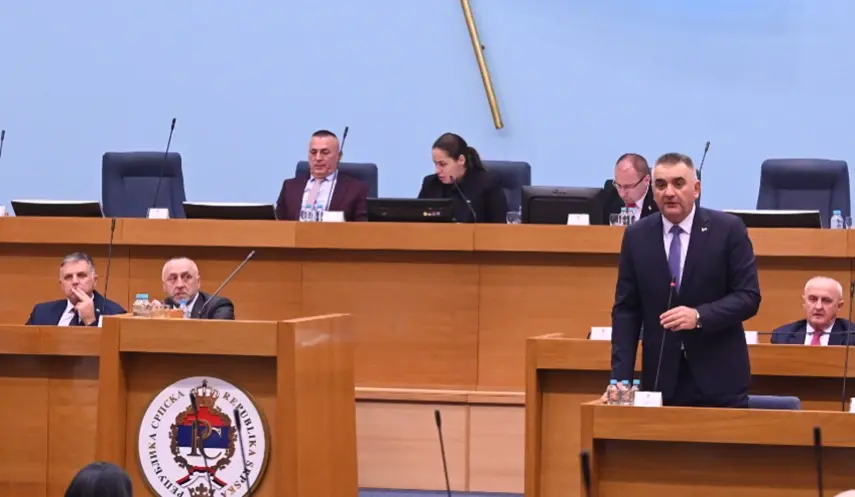
BANJA LUKA, DECEMBER 16 /SRNA/ – Prime Minister of Republika Srpska Savo Minić stated that continued growth of economic activity is expected in 2026, driven by domestic demand and investments, with a slight positive contribution from foreign trade.
Minić noted that the projected economic growth rates of Republika Srpska for the period from 2026 to 2028 are 2.6 percent, 2.9 percent and 3.1 percent, respectively.
He also pointed out that it is known that in 2026 the minimum net wage in Republika Srpska will amount to BAM 1,000, while the lowest net wages, depending on the level of professional qualifications required for a specific job, will range from BAM 1,050 to BAM 1,450.
"A stable labor market, with growth in employment and a slight increase in wages, will enable growth in disposable income, which, together with the positive contribution of government consumption, will sustain domestic consumption," Minić said while explaining the Draft Economic Reform Program of Republika Srpska for the 2026–2028 period under an urgent procedure in the National Assembly.
Minić also pointed out that the implementation of announced investments in energy projects, road infrastructure, healthcare and agriculture is expected to have a positive impact on growth.
"Growth in domestic consumption and investments will consequently lead to an increase in imports, while the expected recovery of external demand, increased exports of services, and the potential opening of new sales channels will enable growth in export-oriented production and total exports. Higher growth in exports compared to imports will result in a slight positive contribution to GDP growth," Minić assessed.
According to him, the fiscal policy of the Government of Republika Srpska aims to maintain a controlled fiscal deficit at a level below three percent of GDP and to keep public debt below 60 percent of GDP.
The Prime Minister of Srpska also stated that the labor market has maintained stability despite the challenges it faced in the previous period.
"Stable developments in the labor market are the result of continuous efforts to improve working conditions, enhance labor market institutions, and encourage employment," Minić said.