KARAN: CONSTITUTION THAT ENDURES - STATEHOOD IS PROCLAIMED IN A MOMENT, BUT CONFIRMED THROUGH CONTINUITY
Republika Srpska - President
02/27/2026
11:47
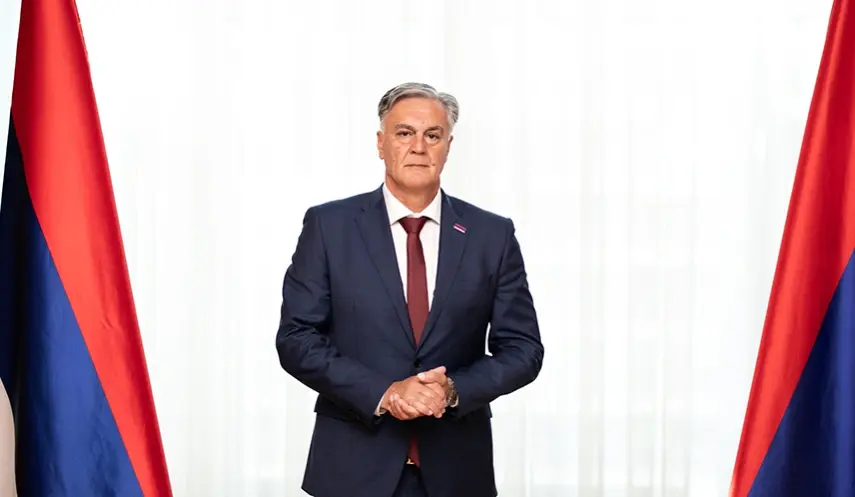
BANJA LUKA, FEBRUARY 27 /SRNA/ - Republika Srpska President Siniša Karan told SRNA that the first Constitution of Republika Srpska, adopted 34 years ago, was a foundational, constitutive, and statesmanlike act that established the political system and institutions of Republika Srpska.
"It was a serious and fateful statesmanlike and legal decision to organize authority, establish institutions, define competencies, and translate political will into a legal order," Karan told SRNA on the occasion of the 34th anniversary of the adoption of the first Constitution of Republika Srpska, emphasizing that it was an act of the highest legal force that ensured the survival of the Serb people on the left bank of the Drina River.
He recalled that under the Dayton Peace Agreement, Republika Srpska was not created as a constitutional subject, as many maliciously claim, but was merely confirmed at the international level.
President Siniša Karan pointed out that Republika Srpska did not come into being in Dayton, but was internationally recognized there as one of the two entities that make up BiH.
"The Constitution of Republika Srpska was adapted to the new constitutional architecture of the complex state of BiH, but it was not abolished. Continuity was not broken. And it is precisely in that continuity that the essence lies," Karan explained.
He stated that the Constitution of Republika Srpska initially functioned as the constitution of an independent state-legal community, and later as the constitution of an entity within a complex state structure.
The President of Republika Srpska emphasized that few constitutions in Europe have such a developmental path and lifespan - from an independent constitutional act to the foundation of an international peace agreement.
"When we speak about the Constitution of Republika Srpska, we are not speaking only about the past; we are speaking about a legal foundation that continues to exist, about a system of government that still functions today, and about institutions that possess the legitimacy and constitutional capacity to make decisions," Karan stressed.
However, he added, when discussing the Constitution of Republika Srpska, it is also necessary to speak about the constitutional arrangement of Dayton BiH, which has its own compromise-based and contractually agreed constitutional identity.
"It was not built on the principle of majority rule, nor does it rest on centralized authority. The constitutional identity of BiH is based on parity, consensus, the division of competencies, the constituent status of peoples, equality of the entities, and mechanisms for the protection of entities and peoples. These are not political formulations or arbitrary options, but explicit constitutional categories," Siniša Karan told SRNA on the occasion of the 34th anniversary of the adoption of the first Constitution of Republika Srpska.
He emphasized that the Constitution of BiH, as part of the Dayton Peace Agreement, clearly stipulates that institutions at the level of BiH possess only those competencies that are explicitly assigned to them, while all other competencies belong to the entities.
"That is the basic constitutional logic of that document. That is the balance that ensured peace," Karan said.
He stated that the mechanisms of balance include parity within institutions, entity voting in the Parliamentary Assembly of BiH, the possibility of protecting vital national interests in the Presidency, and the division of competencies, emphasizing that without these mechanisms, BiH would not be what it is under its Constitution.
"That is why it is important to reiterate that today, Republika Srpska is not demanding anything outside the Constitution of BiH. It is not seeking more than what was signed in 1995. It is seeking the consistent application and respect of a text that has never been formally amended," the President of Republika Srpska emphasized.
He added that the Dayton-defined autonomy of Republika Srpska does not mean secession, nor does it imply destabilization.
"It means functioning within the framework of the original Dayton Peace Agreement, respect for Article III of the Constitution of BiH, and the principle that competencies may not be transferred without a constitutional revision and the authentic, free will of the entities. It means that consensus is not replaced by outvoting, and that protection mechanisms are not treated as obstacles, but as guarantees of stability and a modality of survival," Karan explained.
He added that the 1992 Constitution of Republika Srpska established the institutional backbone of a political system, and that this backbone still exists today.
"The National Assembly, the President of the Republic, the Government, the Constitutional Court, and other institutions of the Republic are not temporary bodies, but constitutional institutions with continuity dating back to January 9 and February 28, 1992," Karan emphasized.
According to him, the 34th anniversary of the first Constitution of Republika Srpska is an ideal opportunity to recall that Republika Srpska was created as a constitutionally organized community, not as an improvisation or the product of hasty decisions; that its strength lies in its institutions; and that its legitimacy is not a matter of day-to-day politics nor something that can be undermined, but rather rests in constitutional continuity.
"Anyone who wants a stable BiH must respect its constitutional identity. That identity implies equality of the entities, the constituent status of peoples, the division of competencies, parity, consensus, and protection mechanisms, so that the balance is not altered without agreement and no parallel political constitution is built outside the text that was signed," the President of Republika Srpska said.
He said that the Constitution of Republika Srpska has endured for more than three decades, having survived war, a peace agreement, political crises, and numerous other challenges, and that it endures because it has legitimacy and institutions and because it is an expression of the constituent will of the Serb people.
"Statehood may be proclaimed in a moment, but it is confirmed through continuity. The Constitution of Republika Srpska of February 28, 1992, is proof of the continuity of Republika Srpska, which remains and endures thanks to the unwavering will of the Serb people to preserve their freedom and their statehood," Karan concluded.