SREBRENICA IS NOT GENOCIDE; SCIENTIFIC AND LEGAL STRUGGLE FOR THE TRUTH MUST CONTINUE
Serbia - Belgrade - conference
12/25/2025
14:40
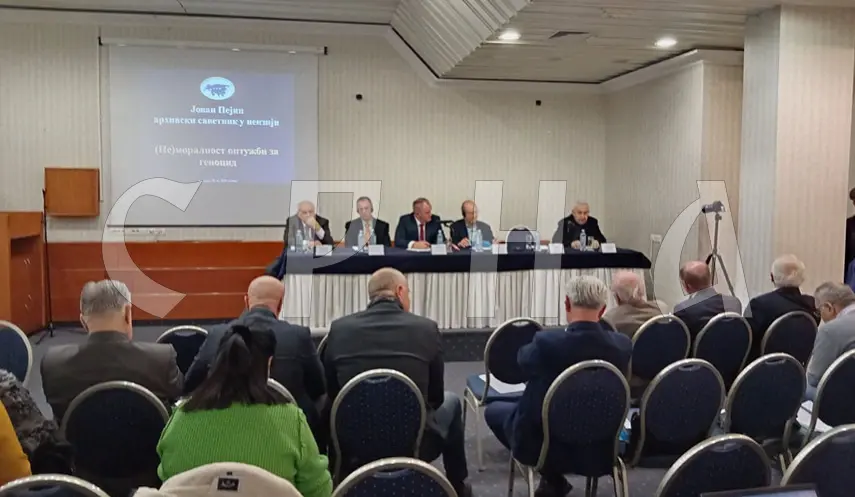
BELGRADE, DECEMBER 25 /SRNA/ - The war crime in Srebrenica has for decades been politicized in order to impose the label of genocide on Serbs, and this event, by its nature and legal definition, is not genocide; therefore, the struggle for the truth about the events of July 1995 must continue, participants of the academic and professional conference "The Politicization of the War Crime in Srebrenica" in Belgrade concluded.
Professor Gideon Grajf explained what constitutes genocide under the UN Convention and other applicable legal instruments, recalling that the International Independent Commission for Investigating Suffering in Srebrenica, which he chaired, unequivocally proved that no such crime was committed in Srebrenica.
"By its nature, genocide implies intent to destroy a substantial part of a particular group, and that does not exist in the case of Srebrenica," he stressed.
Grajf emphasized that even a simple review of the figures makes it clear that the killing of several thousand men did not destroy a significant part of the Muslim population in BiH.
"During the entire war in BiH, only 1.32 percent of the Muslim population of Srebrenica was killed - i.e., 0.4 percent of the total Muslim population - and the share of Muslims in the overall population actually increased," he said.
Professor Nisan Šerifi noted that Raphael Lemkin, the creator of the definition of genocide who played a key role in drafting the Genocide Convention, stated that partial destruction must be such that it affects the integrity or wholeness of a group - namely, mass killing of members of that group.
"Less than 0.4 percent of the Muslims who lived in Srebrenica were killed; moreover, the percentage of Muslims in the total population of BiH increased during the war, and less than four percent of the total population was killed. Thus, there were far more military than civilian victims," he said.
The Director of the Eurasian Security Forum Mitar Kovač the organizer of the conference, said that the Srebrenica case had been politicized from the outset and that `good guys` and `bad guys` had been designated even before trials began.
"Serbs were condemned in advance, but the truth is on the Serbian side and it must be defended - scientifically, legally, and institutionally," Kovač stated.
He emphasized that a shared future for the peoples of BiH cannot be built on the politicization of Srebrenica, nor does reconciliation lie in rhetoric portraying Serbs as aggressors in BiH.
Kovač added that it is necessary to continually insist that not only Muslims but also Serbs suffered in Srebrenica and Podrinje, and to shed light on the truth about Croatia's role in the war in BiH.
Retired archival adviser Jovan Pejin warned that insisting on labeling Srebrenica as genocide is the product of malicious intent aimed at denying the genocide committed against Serbs in the Independent State of Croatia /NDH/.
He noted that around four million people lived in the territory of the NDH before its formation, and that during its existence 1.5 million inhabitants were killed, mostly Serbs.
"An entire nation participated in the crime. That is genocide. In Srebrenica, women and children were not killed. We have footage showing they were transported to Tuzla, even to Serbia, and from there on to Europe," Pejin said.
The conference "The Politicization of the War Crime in Srebrenica" brought together numerous political scientists, historians, and experts who scientifically study the issue of genocide.
Their presentations will be compiled into a proceedings volume to be promoted in April next year and sent to key addresses around the world.