GERMANY PLANS USD 189 BILLION MILITARY BUDGET TO BECOME CONTINENTAL HEGEMON
Europe - Plotan - column
02/17/2026
10:19
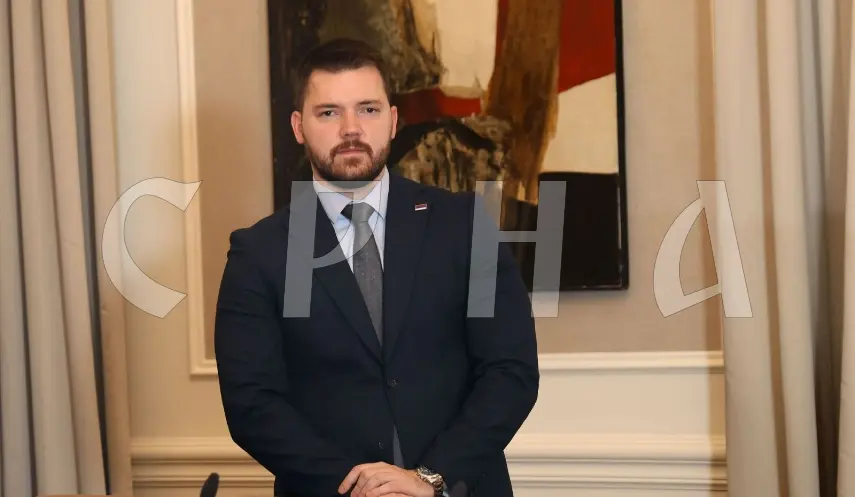
BANJA LUKA, FEBRUARY 17 /SRNA/ - Today, the European Union finds itself at a geopolitical crossroads, and its choice may determine the direction in which the entire European continent will move in the coming years, International and economic policy expert Nemanja Plotan believes.
"The existential crisis of international institutions shaking the entire world, the military withdrawal of the United States from the European continent, the erosion of relations between the Trump administration and European leaders, as well as a period of geopolitical instability, are pushing Europe as a whole into a security competition that could politically and economically destabilize the entire continent," Plotan assessed in his column for SRNA.
We are publishing Nemanja Plotan's column in its entirety:
In 2026, transatlantic relations are undergoing a profound transformation due to the American strategic pivot toward the Indo-Pacific and the prioritization of defending its own territory.
The withdrawal of part of US troops from Romania at the end of 2025 and the beginning of 2026 represents the first concrete step in reducing the American military presence on NATO's eastern flank, signaling that Washington no longer sees Europe as the primary focus of its operations.
The new US National Defense Strategy explicitly states that European allies will assume primary responsibility for the continent's conventional defense, with limited American support in critical areas.
At the same time, President Trump's threats toward Greenland - including ideas of annexation or increased military presence - have shocked European capitals, prompting rapid responses such as the deployment of European military contingents to exercises in Greenland and calls for strengthening European strategic autonomy.
These developments are accelerating EU efforts to strengthen its domestic defense industry, including programs aimed at reducing dependence on American systems and increasing joint procurement.
This shift in the geopolitical landscape is intensifying internal tensions in Europe, where the strengthening of defense capabilities clashes with rising populism and political fragmentation.
While countries such as Germany, France, and Sweden are leading investments in the defense sector, populist and right-wing parties - leading or participating in governments in Hungary, Slovakia, Italy, and the Czech Republic, and leading in polls in France, Germany, and the United Kingdom - frequently question transatlantic commitments, European integration, and the prioritization of defense over social spending.
Their skepticism toward NATO and the EU, combined with sympathies for Trump's approach or even openness toward Russia and China, may hinder coordination at the EU and NATO levels.
In such an environment, European governments face the challenge of justifying increased defense spending to the public while avoiding political backlash that could lead to further fragmentation.
These trends indicate that 2026 will be a crucial year for the transition from a reactive to a proactive European security policy.
Regardless of the outcome of the war in Ukraine, Europe can no longer rely on automatic American protection, which imposes the need for greater investment, better coordination, and the overcoming of internal political divisions.
Success will depend on the ability of key players - Germany, France, the United Kingdom, and the Nordic countries - to maintain momentum, attract private capital, and convince the public that strategic autonomy is essential for the continent's long-term stability.
However, these trends threaten to return Europe to its dark history, as Germany has demonstrated its readiness to become a European hegemon and the largest military power on the continent.
This dynamic revives old European fears, since in the past German strength often led to balance-of-power politics and rivalries rather than stability. With the American withdrawal and reduced focus on Europe, the "American hegemon" that for decades absorbed Europe’s security dilemma is disappearing.
In 2025, Berlin spent more on defense in absolute terms than any other European country, and its military budget ranked fourth in the world, immediately behind Russia.
With plans for annual defense spending to reach approximately USD 189 billion by 2029 - more than triple the level of 2022 - Germany is preparing to once again become a major military power before 2030.
This also includes consideration of reintroducing compulsory military service if the Bundeswehr fails to attract enough volunteers.
France is ambivalent about losing its role as the leading military power should Germany become the new continental hegemon, but fears nonetheless dominate, especially if Berlin shows interest in acquiring nuclear weapons, which currently represent France's only substantial strategic advantage.
On the other hand, Poland - despite earlier statements by Sikorski that he is "less afraid of German power than of German inactivity" - still fears the marginalization of smaller states and possible future shifts in German-Russian relations.
Germany now favors national companies in procurement, using EU exemptions for "essential security interests," which complicates the creation of genuine European defense champions and deepens industrial fragmentation.
While France, Italy, and Sweden use the same mechanisms, none can match Germany's fiscal power - Berlin has loosened the "debt brake" to allow unlimited defense spending, while other countries face higher deficits and less fiscal space.
Berlin's refusal to support large joint EU borrowing instruments /such as defense eurobonds/ limits the chances for an equitable burden-sharing arrangement and reinforces suspicions that Germany seeks to dominate the continent rather than integrate it.
This dynamic is further reinforced by the fact that during the transfer of power from the Biden to the Trump administration, a security vacuum emerged in the Western Balkans - one that Germany has made the greatest effort to fill.
As a result, Christian Schmidt, acting as an illegitimate High Representative, is today merely one lever within Germany's foreign policy machinery, intended to transform Germany into a continental hegemon and enable the unimpeded projection of power in the Balkans.
This is yet another factor suggesting that Germany's long-term plan is political and economic domination of the continent, which could further destabilize Europe as a whole.
For Republika Srpska, this represents an additional challenge, but it has already demonstrated that it can play the role of a political bridge between East and West, especially with the support of Israel and the Trump administration.