BENCUN: IT'S TIME, 30 YEARS AFTER THE WAR, TO GRANT FULL SOVEREIGNTY TO BiH INSTITUTIONS
Austria - BiH
12/02/2025
11:57
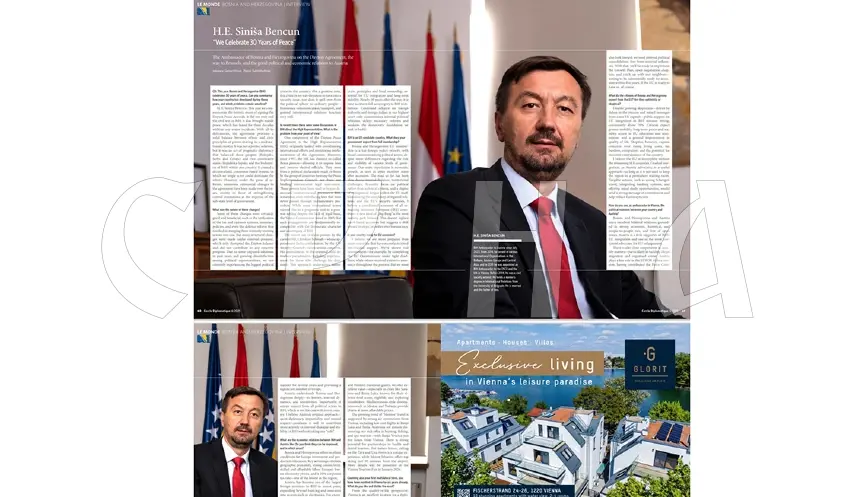
VIENNA, DECEMBER 2 /SRNA/ - The BiH Ambassador to Austria Siniša Bencun emphasized that the Dayton Agreement created a decentralized, consensus-based system in which no constituent people can dominate the others; however, under the guise of reforms, numerous essential changes have been made to it over the years, mostly in favor of strengthening the central institutions and to the detriment of the entities that make up BiH.
"However, many structural changes have been introduced under external pressures, which have only disrupted the Dayton balance and have not contributed to tangible progress. Due to some imposed solutions from previous years and growing dissatisfaction among political representatives, we are currently experiencing the greatest political crisis," Bencun told the diplomatic magazine Cercle Diplomatique.
He pointed out that a positive aspect is that this crisis in no way threatens to escalate into a security problem, nor does it spill over from the political sphere into everyday life - business, communications, transportation, and general interpersonal relations are functioning very well.
In response to the observation that there have recently been certain discussions in BiH regarding the "High Representative to BiH," Bencun explained that one of the components of the Dayton Peace Agreement is the institution of the High Representative, who was originally tasked with coordinating international efforts and monitoring the implementation of the agreement.
"However, since 1997, the High Representative has been assuming the so-called Bonn powers, which allow him to impose laws and dismiss democratically elected representatives. These powers stem from a political declaration adopted in Bonn by a group of states forming the so-called Peace Implementation Council, and not from any legally binding international instrument.
These powers have been used to bypass democratic institutions and processes in BiH, sometimes even to impose laws that never went through parliamentary procedure. Although some international actors, despite the lack of a legal basis, viewed this as a pragmatic tool in the post-war environment, the Venice Commission already in 2005 emphasized that such measures are fundamentally incompatible with the democratic character and sovereignty of BiH," Bencun pointed out.
The recent use of these powers by /the fake High Representative/ Christian Schmidt, whose appointment has not been confirmed by the UN Security Council, Bencun says, raises serious concerns.
"His amendments to the criminal law introduce penalties, including imprisonment, for those who question his decisions. Such an approach undermines democratic principles and domestic ownership of processes, which are crucial for EU integration and long-term stability," Bencun stated.
He emphasized that it is time, almost 30 years after the war, to grant full sovereignty to the institutions of BiH, because continued reliance on an external authority and foreign judges in the BiH Constitutional Court only further contaminates internal political relations, delays necessary reforms, and weakens the democratic foundations that are being built.
Speaking about BiH’s EU membership, Bencun stated that BiH is better prepared for the European path than some countries that have recently received substantial support.
"We have demonstrated genuine commitment. For example, by completing the EU questionnaire within short deadlines, while others received extensive assistance with this task.
However, we must also look internally: we need internal political consolidation, free from external influences. In this way, we will be ready to implement the Growth Plan, open negotiation chapters, and catch up with our neighbors - to be essentially ready for accession within five years," Bencun said.
He added that Austria is very vocal regarding BiH’s EU membership and is one of the most consistent promoters of EU enlargement.
According to him, there is also close cooperation on security issues between Austria and BiH, particularly in combating illegal migration and organized crime.
"Austria understands the essence of BiH - its history, internal relations, and sensitive issues. Unlike some other countries, it enjoys the trust of all political actors in BiH. I believe that the traditional Austrian approach - quiet diplomacy, impartiality, and mutual respect - enables active participation in internal dialogue and the stability of BiH, without `taking sides,`" Ambassador Bencun stated.